The Phillips Collects: Sonja Sekula
Collection
The Phillips Collection recently acquired an untitled print by Swiss American artist Sonja Sekula, an artist also featured in the exhibition Miró and the United States. Chief of Staff and Board Liaison Caitlin Hoerr writes about the artist and her impressive yet turbulent life and artistic career.
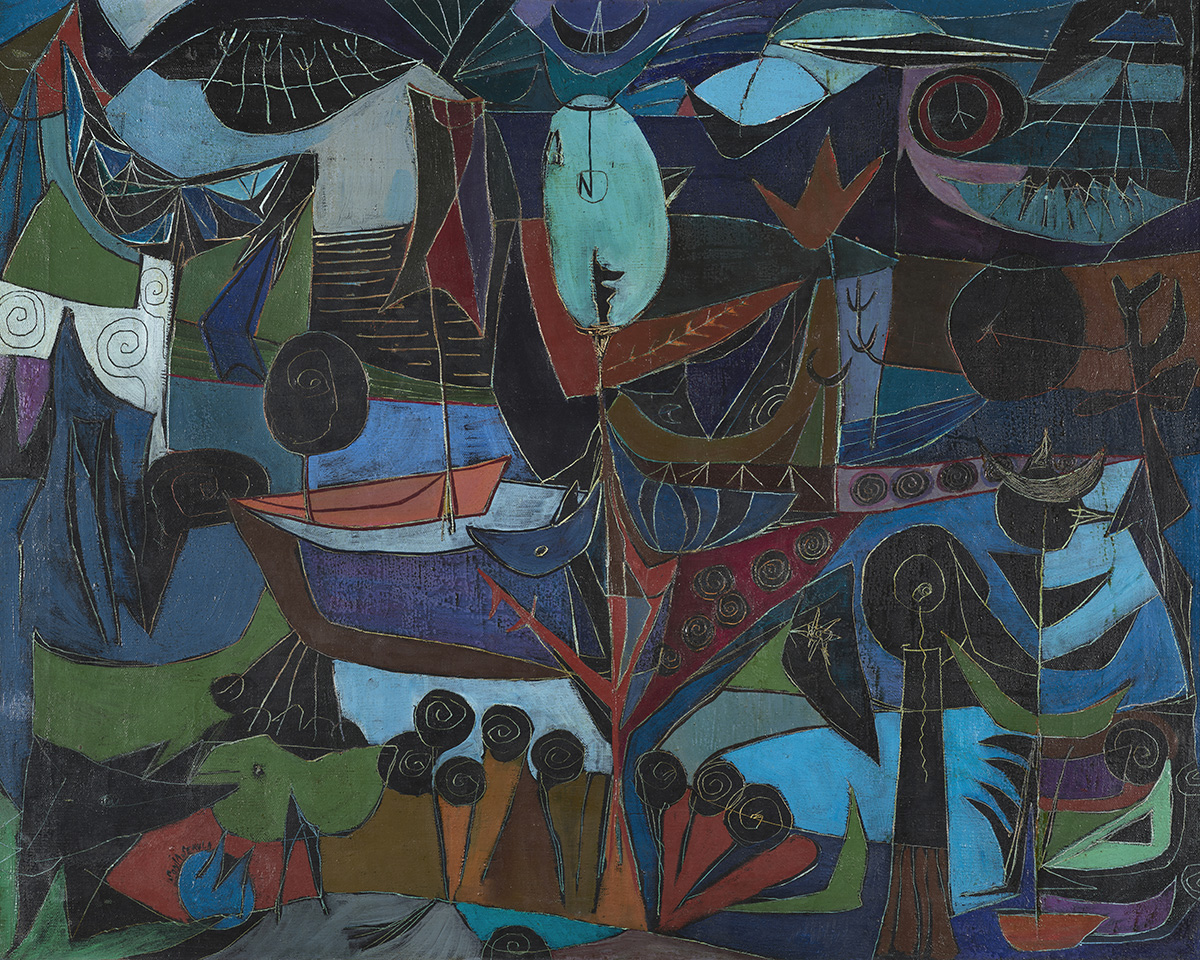
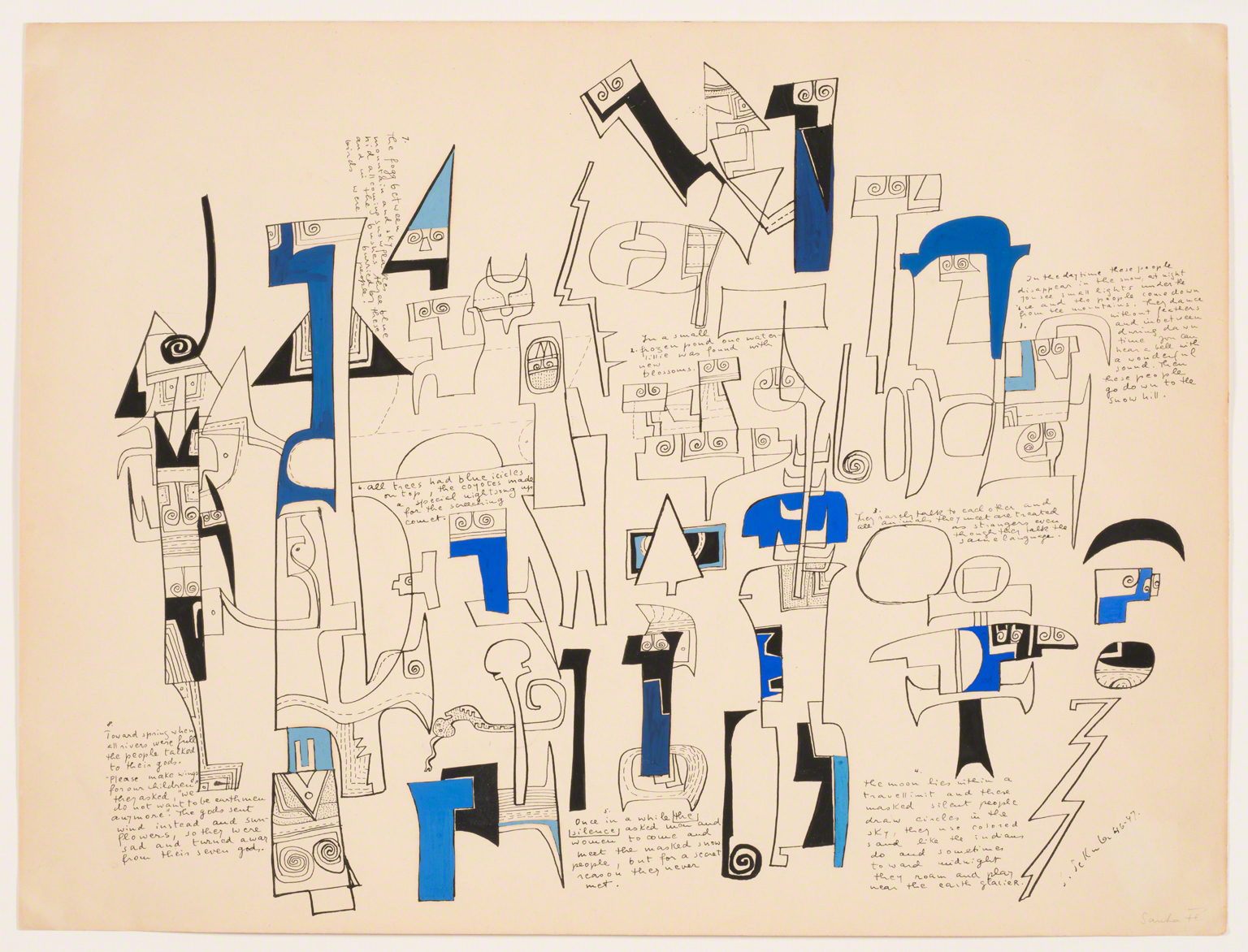
Sonja Sekula’s African Moonsun, 1945, is featured in the third floor special exhibition Miró and the United States. Sekula’s “all-over” approach of filling the entire canvas echoed the style of Joan Miró and the other Abstract Expressionists. One floor down, in our second-floor collection galleries, there is another conversation between the two artists—Joan Miró’s Woman and Bird in front of the Moon, 1947, is on view next to Sonja Sekula’s Untitled, 1946-7, both recent acquisitions. Sekula’s ink and gouache on paper has bold lines and crisp blues and blacks, and handwritten notes in and among the figures.
Born in Switzerland, Sekula arrived in New York in 1936, and soon became part of an influential circle of international artists, architects, musicians, and writers. She was immersed in ideas of surrealism, exhibiting alongside major figures of Abstract Expressionism, and was friends with American and European creatives such as Merce Cunningham, John Cage, André Breton, Robert Motherwell, and Max Ernst. Her work was featured in New York shows in the 1940s and 50s: In 1943, Peggy Guggenheim included her in a hugely important exhibition of female artists; she exhibited at the Betty Parsons Gallery; and her artwork was included in the influential 1951 Ninth Street Show that featured Lee Krasner, Philip Guston, Hans Hofmann, and Grace Hartigan, among others.
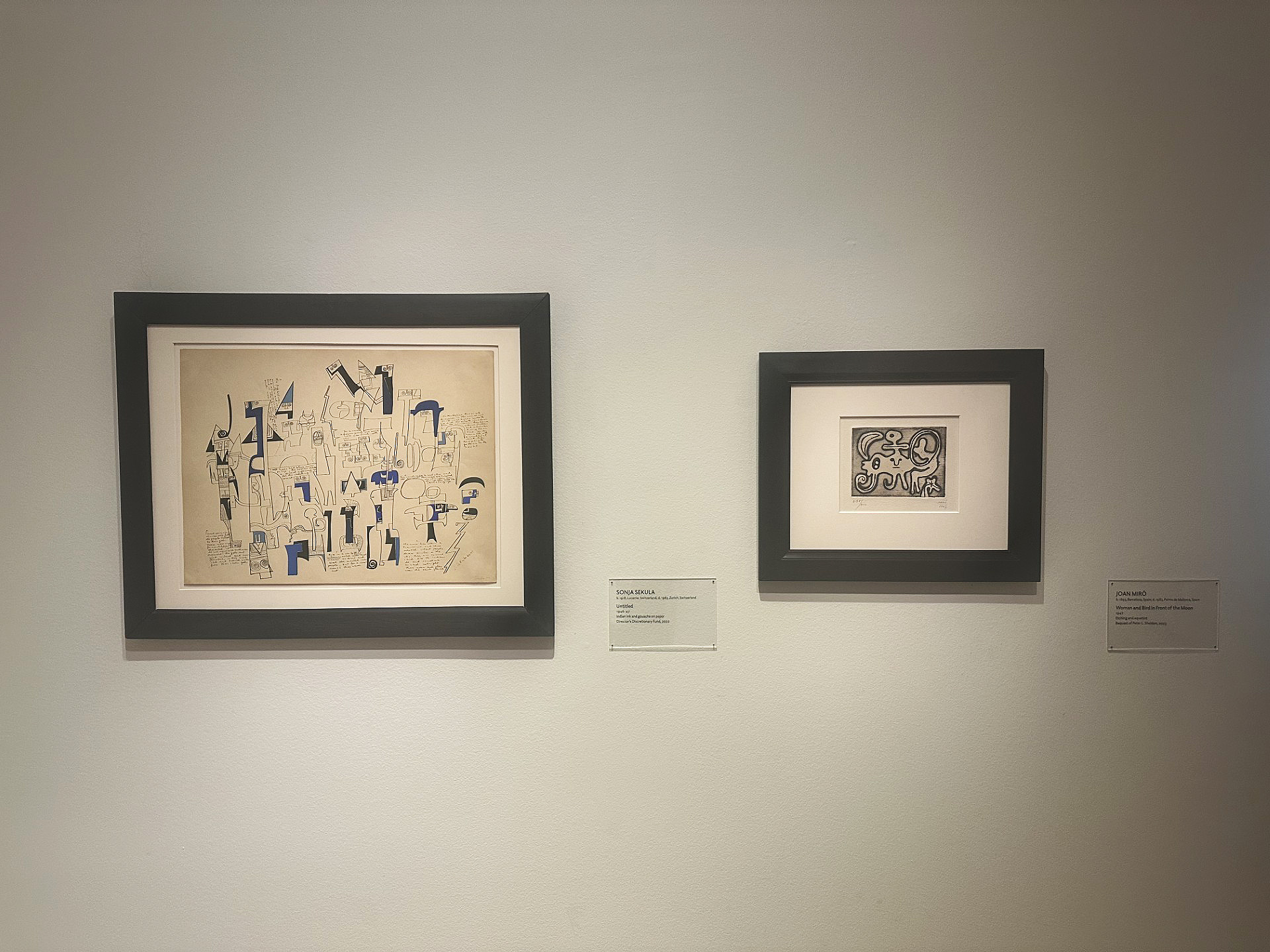
Sekula’s artwork is characterized by her experimentation with and exploration of abstraction and surrealism, vacillating between symbols, amorphous forms and lines, and bright explosions of color and density. Much like Miró, Sekula’s art was inspired by her transatlantic journeys, for Sekula between New York and Switzerland, where she often traveled to receive treatment for mental illness. In a 1947 letter to her mother, Sekula writes: “I think of all the contemporary American poets and artists who represent their outlook on this strange country and I find myself beginning to realize that I shall be one of them, I shall be an American painter.” This untitled work on view, in particular, is inspired by the American Southwest, especially Hopi and Zuni rituals that she witnessed in Santa Fe, New Mexico. African Moonsun similarly explores her interest in Native American and African visual cultures.
An “out” lesbian, Sekula documented relationships with women throughout her life, noting that she channeled her frustrations and desires into her paintings. Despite the efforts of her doctors, and the likely external pressure of a homophobic art world, Sekula wrote movingly in 1960: “Let homosexuality be forgiven … for most often she did not sin against nature but tried to be true to the law of her own—To feel guilt about having loved a being of your own kind body and soul is hopeless.”
Supporters of Sekula’s works feel that she’s been forgotten. During her lifetime, she exhibited alongside and was creating art next to artists that we consider canonical today, such as Joan Mitchell and Helen Frankenthaler, and she received positive, even glowing, reviews from critics. However, there are many reasons why her work may have faded into obscurity after her untimely death in 1963. She was repeatedly hospitalized, and underwent conversion therapy, her doctors perhaps believing that her lesbianism was a symptom of mental illness. Her work was compared unfavorably later in her life to other rising stars. And she preferred to create smaller-scale works, often on paper, despite knowing that the larger paintings her contemporaries were making at the time sold better and were more readily collected.
However, the conversations between Sekula and other artists in the permanent collection proves that her visual language is still compelling and enriches our understanding of modern art.