Bonnard at the Phillips
Collection
A new installation in Gallery 202 highlights the art of Pierre Bonnard.
“Our generation always sought to link art with life. At that time I personally envisaged a popular art that was of everyday application: engravings, fans, furniture, screens.”—Pierre Bonnard
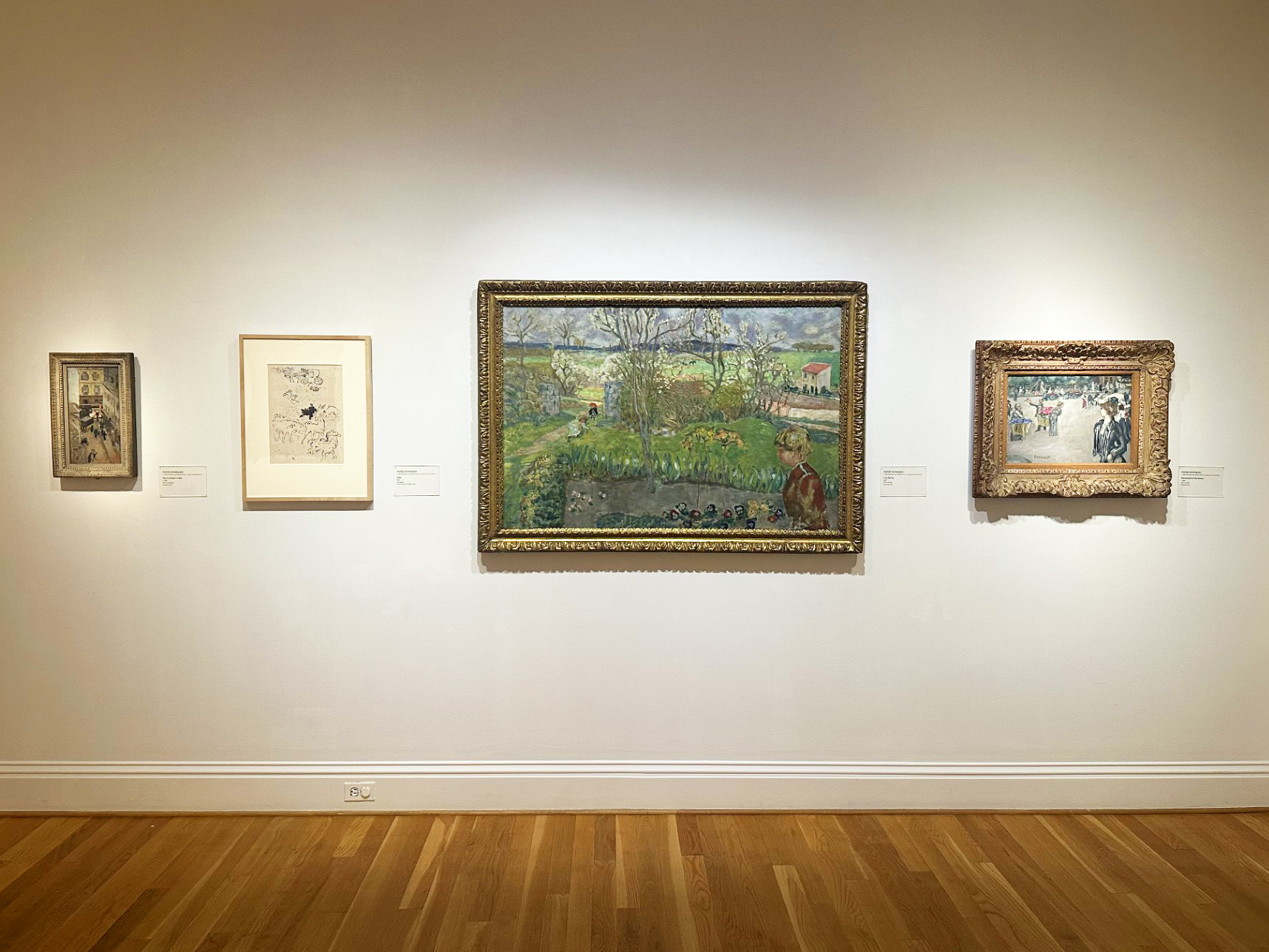
In 1925, Duncan Phillips discovered Pierre Bonnard (1867-1947) at the Carnegie International exhibition in Pittsburgh and bought Woman with Dog (on view in this room) well before his contemporaries took interest in the French artist. Phillips’s passion for the painter, whom he considered the heir to Pierre-Auguste Renoir, fueled a growing collection of over 30 works, the largest outside France. This special installation celebrates the museum’s most recent acquisition by Bonnard, Nannies’ Promenade or Frieze of Carriages, a gift from Roger Sant.
Bonnard depicted luminous scenes of everyday life through an expressive language of sensuous color, line, and form. Early in his career, he was a member of the avant-garde artistic group Les Nabis (The Prophets) who sought to “link art with life.” A highly successful painter and printmaker, Bonnard lived in and around Paris, including near Claude Monet’s Giverny in Vernonnet, Normandy, where he painted views of the Seine. In the mid-1920s, he bought a villa in Le Cannet, near Aix-en-Provence, on the French Riviera, where he settled permanently in his final years. This room captures the breadth of Bonnard’s oeuvre, from his Parisian urban scenes and intimate domestic interiors, to his garden landscapes from northern and southern France. The words of Duncan Phillips still ring true: “With us Bonnard is at home.”’
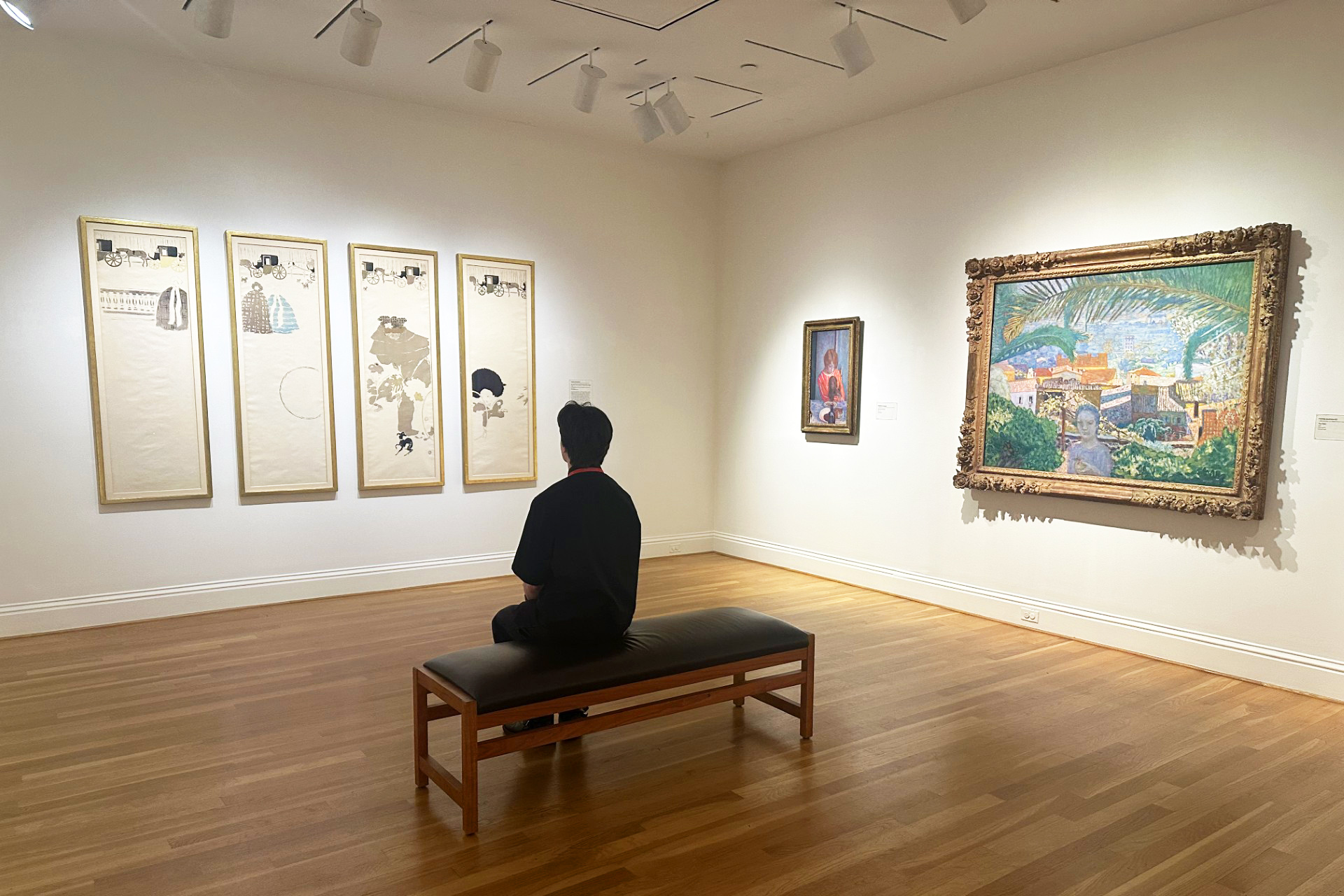
Bonnard created Nannies’ Promenade or Frieze of Carriages five-color lithograph after a painted folding screen he made in 1894. Nannies’ Promenade or Frieze of Carriages exemplifies the artist’s embrace of the compositional devices of Japanese ukiyo-e (pictures of the floating world) woodblock prints: asymmetry, flattened space, and sinuous lines. Spread across the four panels, Bonnard places a mother with her children and nannies on an expressive off-white ground that the artist identified as the Place de la Concorde in Paris “when there is dust and it resembles a mini-Sahara.” The line-up of horse carriages in the upper register of the screen and the overlapping hoops in its center draw the eye from frame to frame, evoking the feeling of the latest experiments with moving pictures.