Massilia, Marseille, and Modernity: Puvis de Chavannes at The Phillips Collection
Collection
Summer 2026 Curatorial Intern Kristen Lauritzen on the installation of Pierre Puvis de Chavannes’s monumental sketches in Galley E.
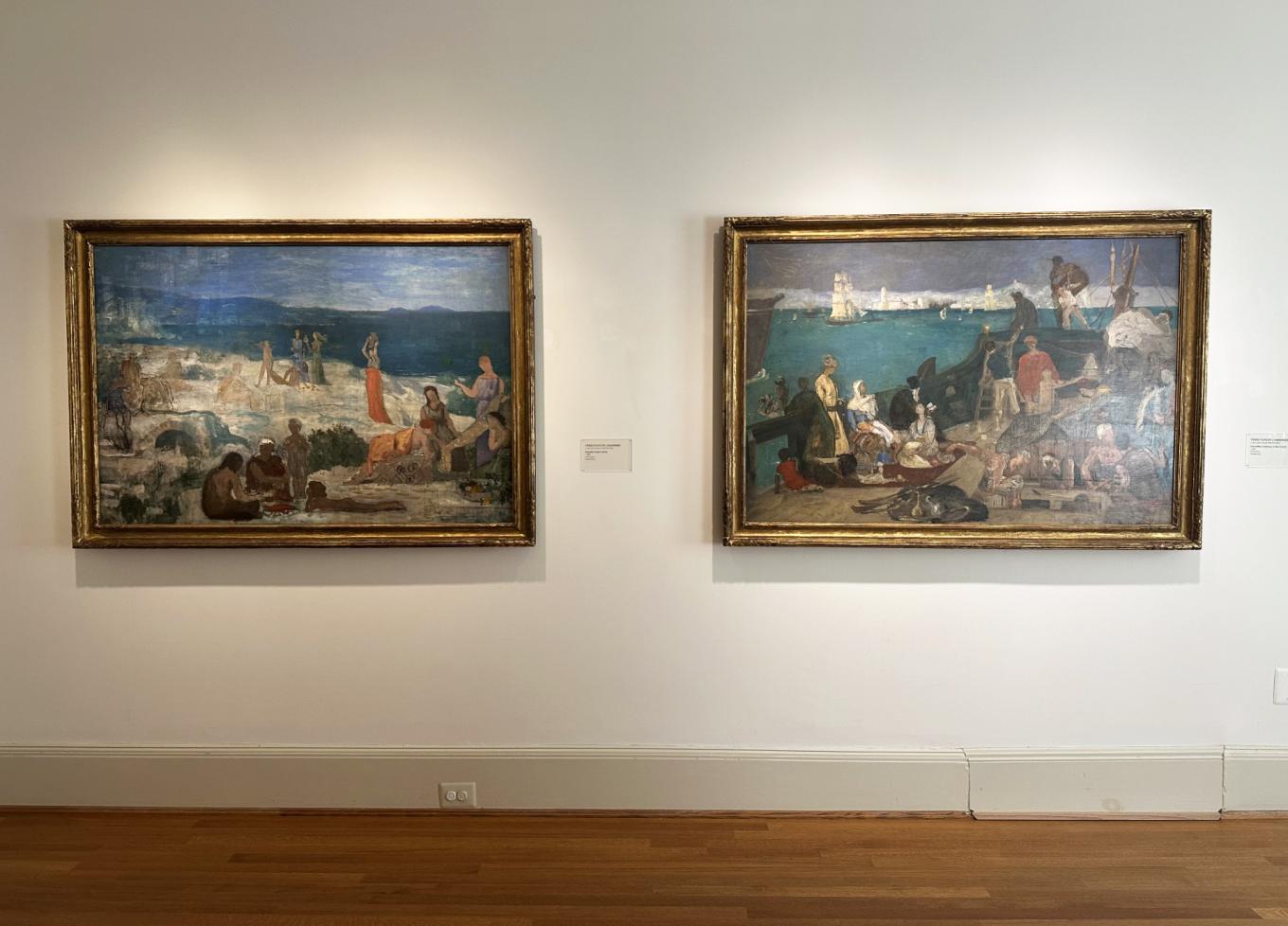
Left to right: Pierre Puvis de Chavannes, Massilia, Greek Colony (c. 1868–69) and Marseilles, Gateway to the Orient (c. 1868–69)
“For the brief time when these sketches were on his easel he was a searcher for he knew not what, a taster of rare flavors of comingled color, a gleaner after time and its personal memories.” With these words, Duncan Phillips described French artist Pierre Puvis de Chavannes’s approach to his two monumental sketches, Massilia, Greek Colony (c. 1868–69) and Marseilles, Gateway to the Orient (c. 1868–69), recently reinstalled in Gallery E of the House. Phillips conjures an image of a curious artist, one confident enough for experimentation, yet humble enough to acknowledge the unknown. Indeed, when standing before these two paintings—with their rapid brushstrokes and palimpsest figures—one is able to perceive the mystery, the sense of adventure with which the two paintings are imbued.
Puvis created these large preparatory sketches for two murals that adorn the staircases of the Musée des Beaux-Arts in the Palais Longchamp in Marseille, France. The paintings were commissioned following the completion of Puvis’s decorative murals in Amiens in northern France. Initially, the commission stated that the Marseille murals were to present pagan and Christian narratives of the city; Puvis, however, chose to depict the founding of the city by the Greek people (Massilia, Greek Colony) and the city as a modern port city, a gateway to the East (Marseilles, Gateway to the Orient). In the latter work, Puvis paints from the vantage of an outsider, placing the viewer on the deck of a ship as it approaches the city from the sea.
These extraordinary works make visible the artist’s process: in the distant left corner of Massilia, Greek Colony, we can just make out the remnants of architecture, perhaps the beginnings of a temple. The visible gridlines at the bottom right of the painting remind us that this is a study for a much larger work, while the half-erased, charcoal-outlined ghosts throughout hint at the fully realized figures of the Palais Longchamp murals. Further, these works occupy a liminal space, both in the artist’s oeuvre and Duncan Phillips’s collection. As preparatory sketches, they are both unfinished and complete, not necessarily created for public display, yet essential for the finalized murals. In this way, the sketches contrast with the other, more polished works that hang in Gallery E, such as the jewel-like work The Wine Press, also by Puvis. As museumgoers, it is rare to be granted this glimpse behind-the-scenes of the artist at work, as though we are seeing something the artist never intended us to see.
Puvis had a complicated relationship with easel paintings such as these. Art historians and critics have described the importance of in situ work for the artist—murals created for specific walls, statues for certain pedestals, and altarpieces for their intended altars(1). What to make of these works that defy such descriptions of Puvis’s artistic intentions? Would these art historians, critics, or Puvis himself take issue with The Phillips Collection’s chosen manner of display?
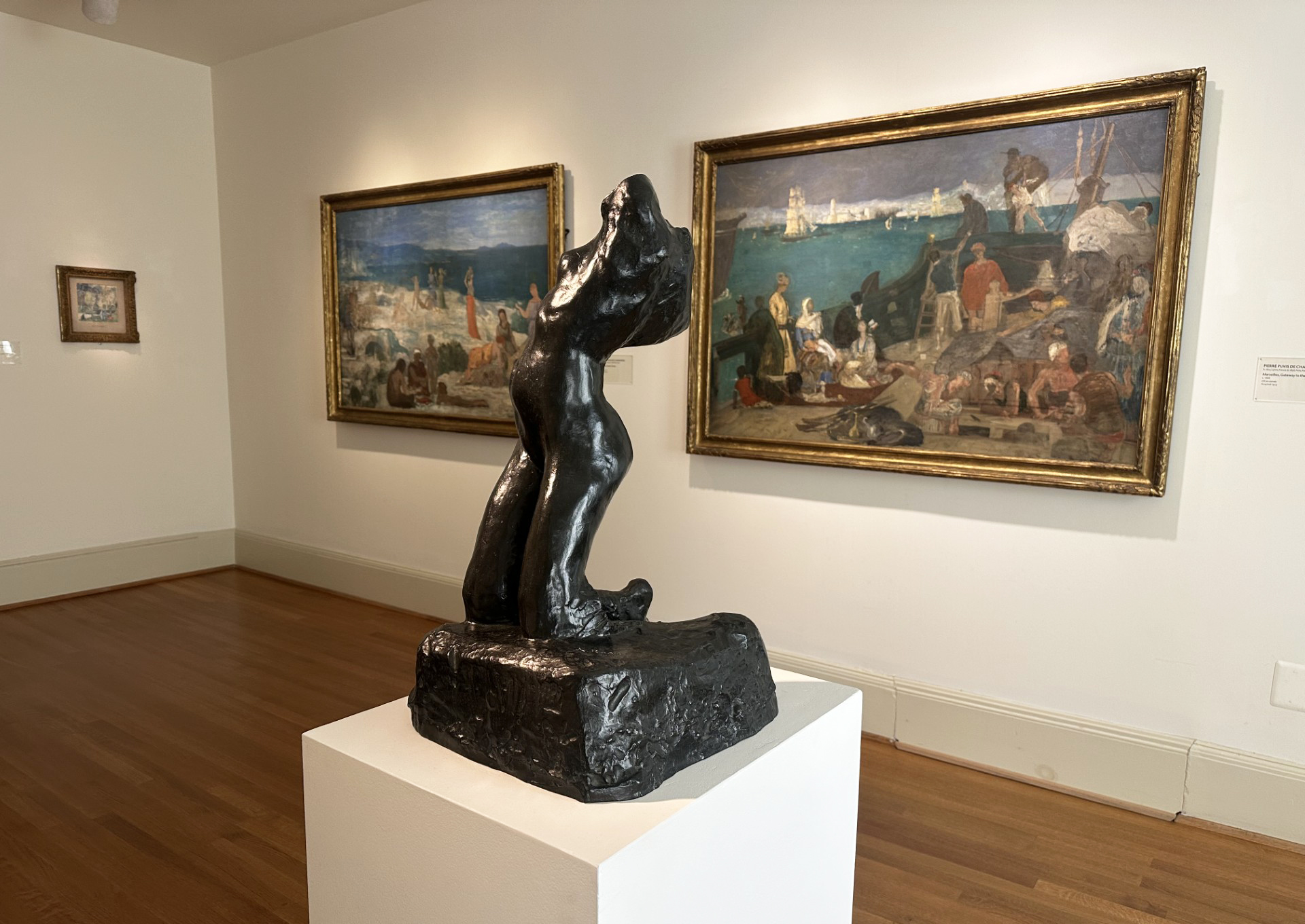
Eschewing these historical preferences, The Phillips Collection has a documented history of proudly displaying Massilia, Greek Colony and Marseilles, Gateway to the Orient since their early acquisition in 1923. In 1929, the two works were included in the exhibition Sources of Modern Art, alongside works like Paul Cezanne’s Self-Portrait and Pierre-Auguste Renoir’s Luncheon of the Boating Party. The current display of Puvis’s works, in Gallery E, similarly situates the artist as distinctly modern. Massilia and Marseilles face two works by Ker-Xavier Roussel on the opposing wall, an artist associated with Les Nabis and contemporaneous with Édouard Vuillard and Pierre Bonnard. Near the entrance to the room hangs The Small Bather by Jean-Auguste-Dominique Ingres, a Neoclassical painter born in the late-18th century. Puvis converses with Roussel, their unexpected colors and loose brushstrokes in stark contrast to the clean lines of the Ingres work. Gallery E, anchored by Puvis de Chavannes’s works, invites viewers to consider the evolution of modernity—both across art history and within the walls of America’s first museum of modern art.
Notes:
Marius Vachon, Puvis de Chavannes (Paris: Braun, Clément, 1895), 33; Kenyon Cox, Old Masters and New: Essays in Art Criticism (New York: Fox, Duffield & company, 1905), 211.