“The World Opened Up for Me”
Collection
Charles Rumph Research Fellow Kelly Richman-Abdou shares a recent discovery while working through photographer Charles Rumph’s archival materials.
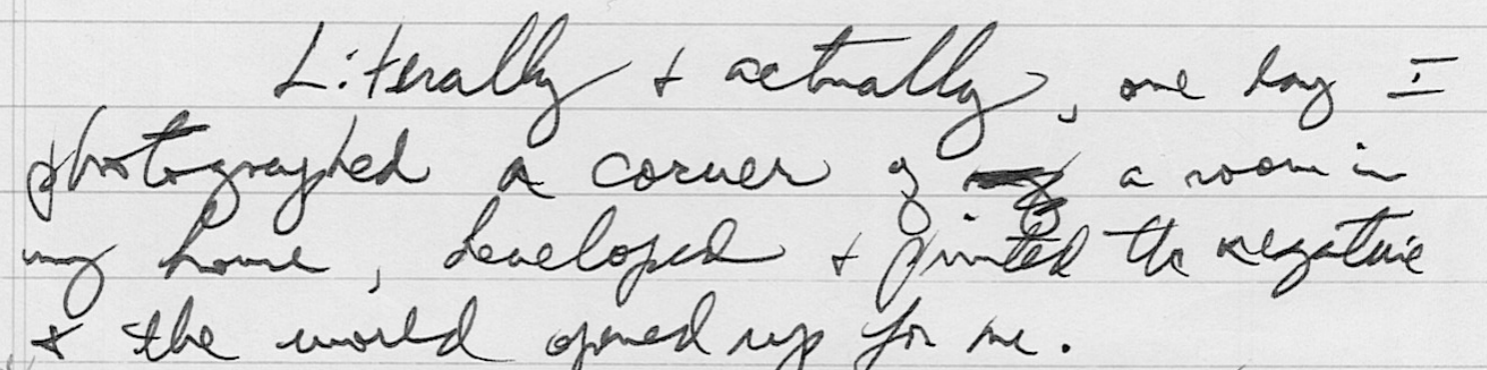
“Literally and actually, one day I photographed a corner of a room in my house, developed and printed the negative and the world opened up for me.”
I came across this statement—handwritten on loose-leaf paper—while working through photographer Charles Rumph’s archival materials. I was struck by how aptly his words captured something I have come to recognize in my work as Research Fellow for his collection: what has been seen countless times can suddenly “open up” when viewed from a different perspective. For me, much of that discovery has happened in the archive itself, where an unexpected handwritten note like this one can offer a new way of seeing. Contact sheets, exhibition materials, and other archival traces can similarly shift the way we see an image, revealing details that might otherwise remain hidden—and even prompting us to reconsider what we were looking at in the first place.
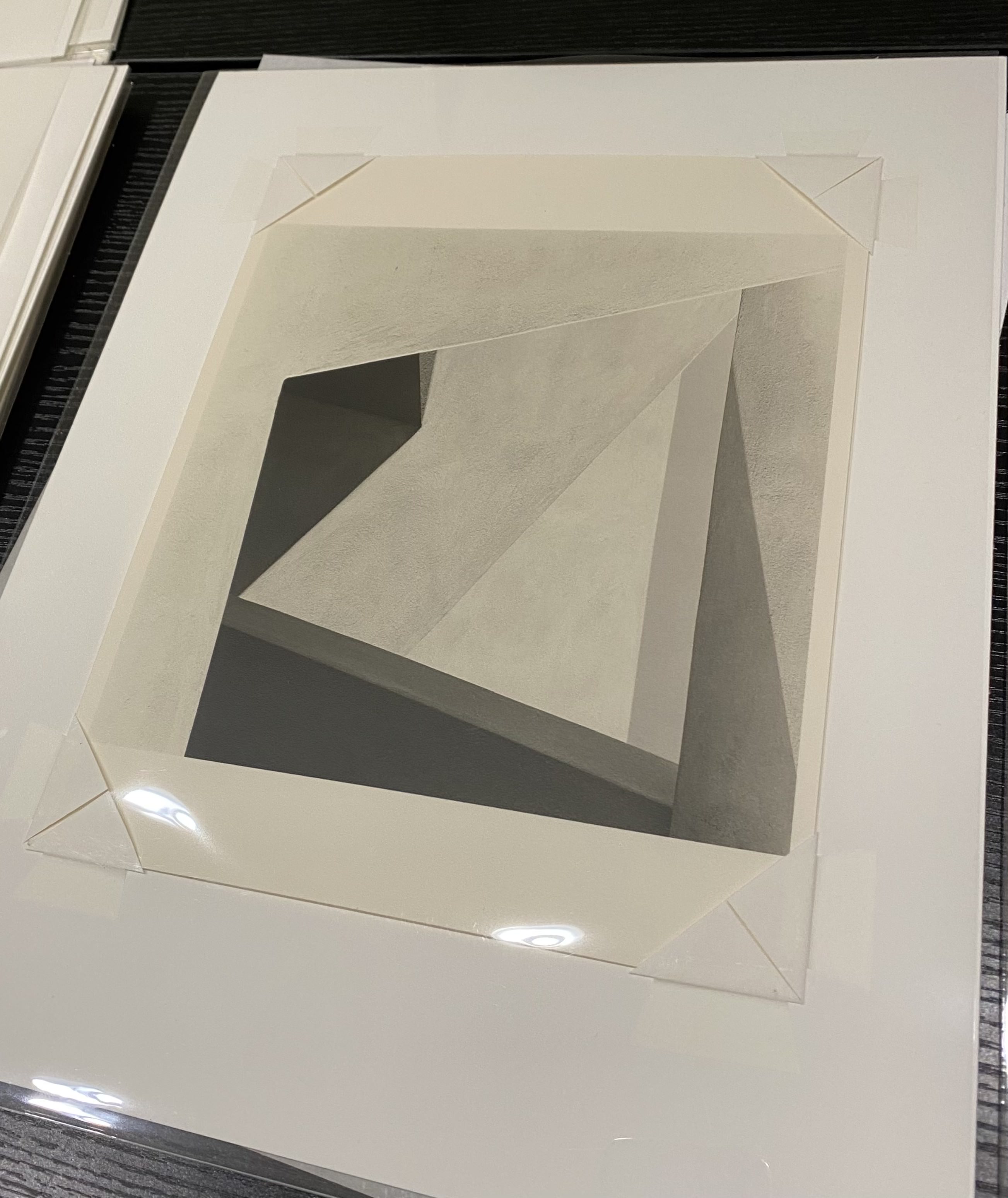
One of the clearest examples is a photograph that had no title when Associate Curator Renée Maurer and I first encountered it: an abstract composition of geometric planes, angular forms, and a nuanced interplay of black, gray, and shadow. We were immediately drawn to its bold composition and added it to our exhibition checklist, undeterred by the absence of a title and hopeful that further research would reveal more about the image. As it turned out, we didn’t have to look far. While reviewing Rumph’s papers, I came across a flyer for Illusions of Place, a 2001 exhibition of his work at The Georgetown Frame Shoppe in Washington, DC. There, we found the photograph reproduced in the opposite orientation from the way we had been viewing it. Suddenly, it clicked: we had been looking at it upside down! And there, beneath the image as it was meant to be seen, was a title: Studies of a Greek House No. 7.
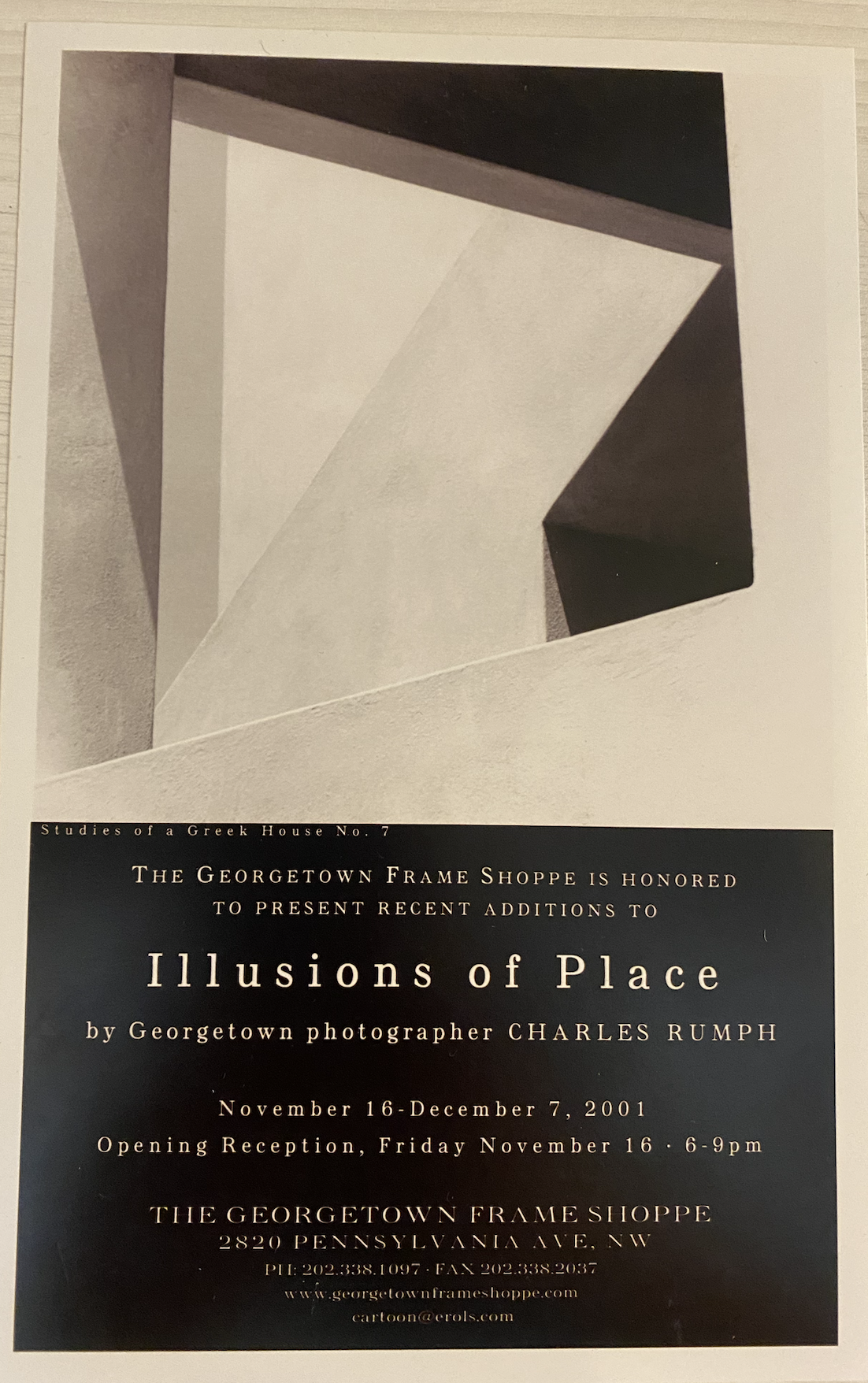
That revelation sent us back into the archive in search of the corresponding contact sheet. When we found it, we noticed that several frames showed the image from farther away, revealing a more expansive composition than the tightly cropped final print. Suddenly, what had appeared to be an abstract arrangement of geometric shapes became something else entirely: the corner of a building, opening onto a landscape beyond. A memo written in marker provided one final clue to the scene: “Santorini.”
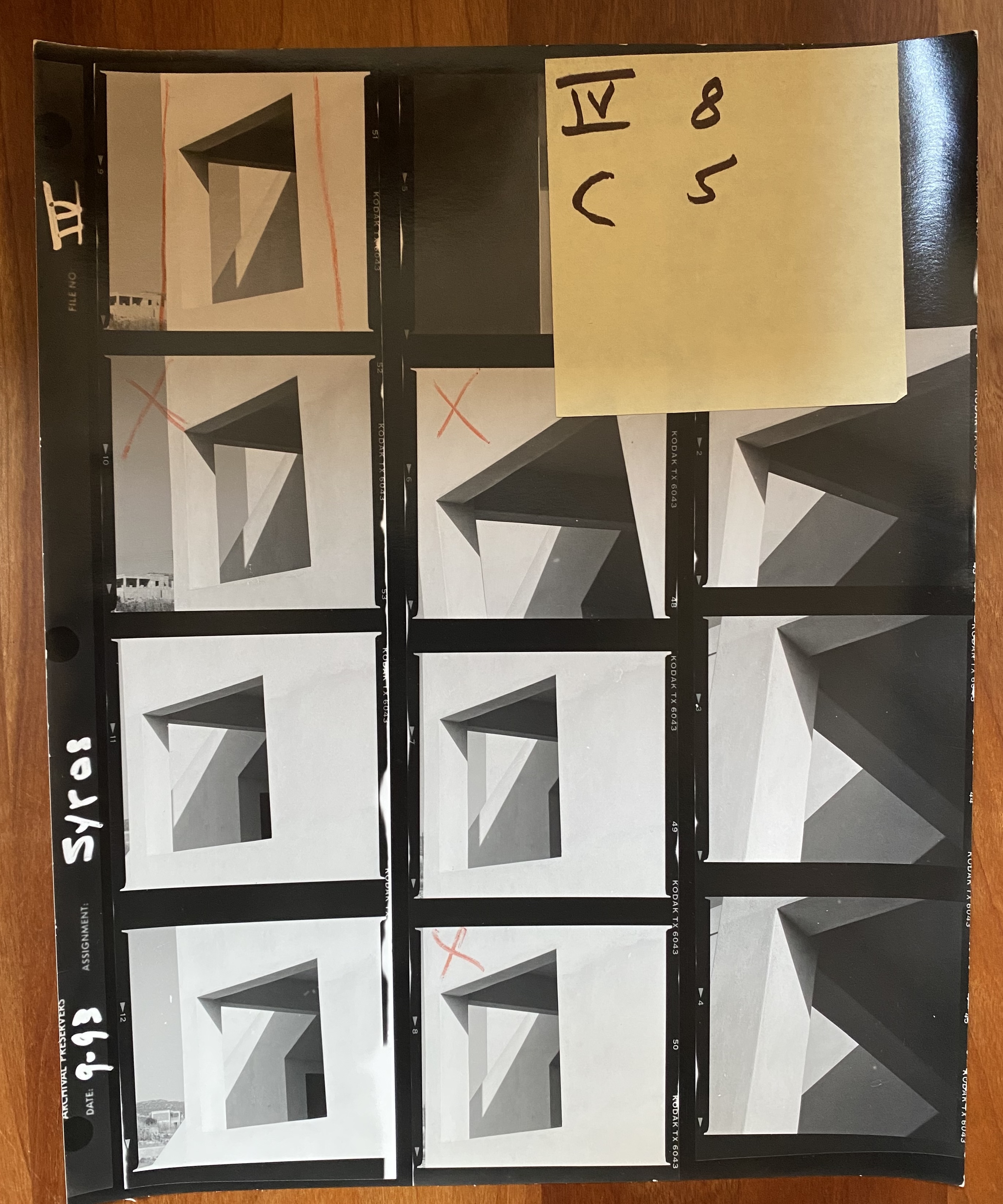
Discoveries like this are part of what I love about being an art historian: the chance to look closely, follow a clue, and sometimes discover that I was seeing something all wrong. That kind of looking has been central to my work as a Research Fellow. As I have been digging deeper into the archive, Renée and I have also been steadily moving toward the 2027 exhibition. Catalogue work is underway, object files are taking shape, and we are working to finalize our checklist—which includes Studies of a Greek House No. 7 (positioned correctly, of course). Together, this work is bringing the exhibition into focus, and I hope it can reveal what lies beyond the edges of a photograph—“literally and actually.”