Awestruck from the Beauty
Education & Community Engagement
The Mach family are longtime members of the Phillips. Their younger daughter, Tatum, wrote her personal essay for college last year about her deep connection to the museum, reprinted here. This August, Tatum started her freshman year at WashU, where she plans to major in art history. Good luck, Tatum, and please come back to visit!
Today, once again, I am going to The Phillips Collection alone. Though once intimidated, I now revel in my independence. I seek solace in my own company, enjoying the short walk from my house. The collection feels like my own hidden gem, a magical intimate space. It lives at the heart of my version of DC—away from the sprawling National Mall and recognizable monuments. The closer I get to the museum, the more the city noise fades. Then, finally, there is silence. I enter those familiar rust-colored doors, and my mind is at peace, free to explore this haven for my imagination. The works in the permanent collection are old friends. Like a magnet, I am pulled from one room to another, latching on to each piece.
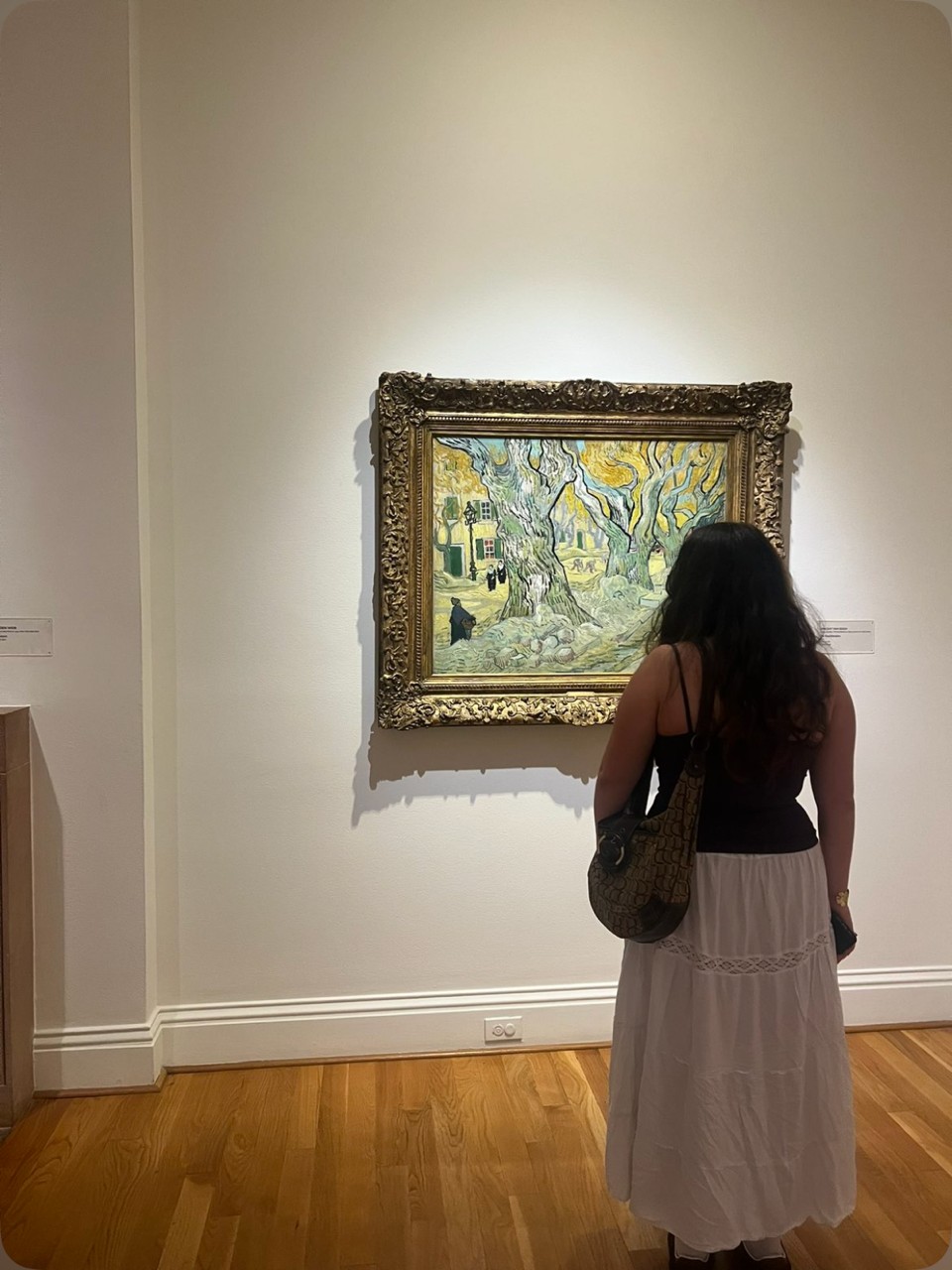
I walk to the top floor to see the special exhibit featuring work by Alphonse Mucha. Hundreds of art nouveau posters and images decorate the walls. Gaudy, confident women stand proudly. They gaze at me, seemingly nodding their support as I stroll alone. Gold paint and rich blue outlines dance through the exhibit, drawing me closer. The main event patiently waits for me at the end of the gallery.
A box of vinyls, featuring album art inspired by Mucha, with a set of headphones calls my name. Above the table is a sign that reads: “Put on headphones, place record here,” commanding, yet inviting. While sifting through the records, I spot a brown cover with glowing green tendrils like the hair on Mucha’s women: the album “Yessongs.” As I place the needle on the record, I am transported back a decade to the car, my dad behind the wheel. I’m humming along to the tune in the back seat—the words are too difficult for my little mind to remember. He turns to me: “Who sings this?” He loved to quiz me, seeing if I had truly absorbed all the rock history. He would beam with pride when I recognized Lou Reed’s baseline in A Tribe Called Quest’s “Can I Kick It.” To this day, he still tests me, making sure I never lose my music knowledge.
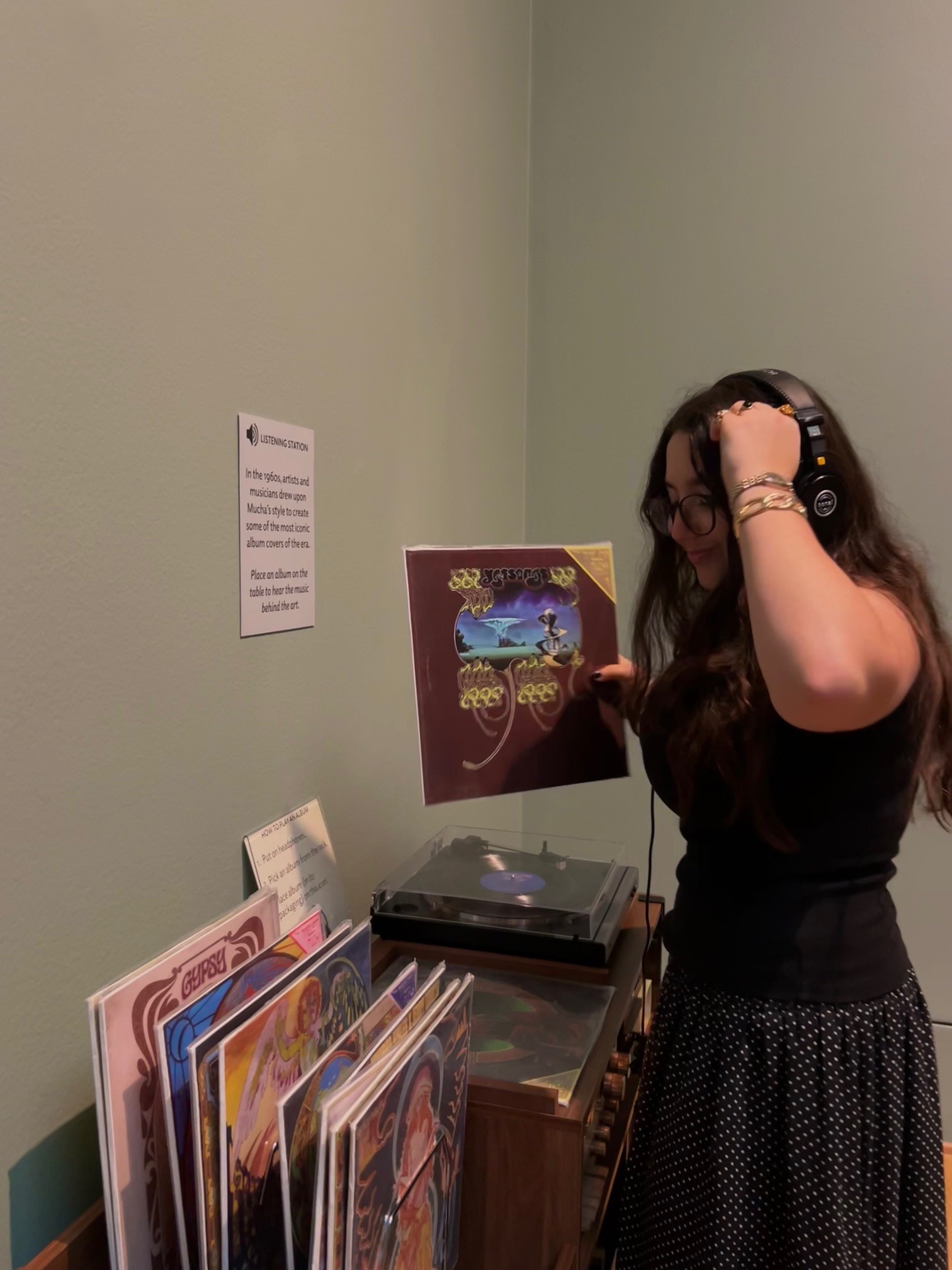
I marvel at the set-up: a table of vinyls with headphones, sitting in the middle of an art museum. It is essentially made for me, a perfect pairing of sonic and visual expression. As the tune flows through my ears and into my body, the figures fly off the walls, dancing through the air. More than just notes and rhythm, the music builds its own world. I watch the scene I have created, as art interacts with art. I’ve curated a seamless exhibit of my life. In this moment, I am both in the car as a child and in the museum as a teenager. Music and art work in tandem, creating a space for me alone. It’s a place that venerates originality and pushing boundaries, a contrast to the world outside. I’ve found that society’s focus on routine and rationality moves us further from fantasy and wonder. We fear that our heads are in the clouds, so we chain ourselves to the ground. As a disciple of The Phillips Collection, I have learned to resist these restrictive narratives. The space is a refuge from conformity. Frequenting this monument to creativity has not only helped me embrace independent museum exploration, but has also made me comfortable with independence of thought.
Leaving the museum, I am profoundly satisfied. Awestruck from the beauty, I choose not to allow the city noise to dominate my walk home. I put on my own headphones and hold onto that wondrous feeling a little longer.