The Phillips Collects: George Morrison and Terran Last Gun
Collection
The Phillips Collection is proud to share two recent acquisitions of Native American art that expand and diversify the museum’s collection of modern and contemporary art: Untitled (1961) by George Morrison and Maintaining Ancient Retro Futurism (2026) by Terran Last Gun.
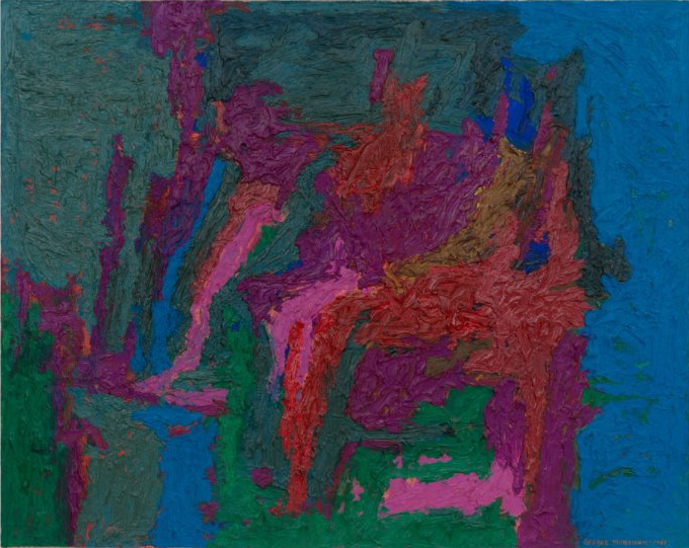
George Morrison (Ojibwe, Chippewa City, Minnesota, 1919–2000) was a pioneering Native American modernist whose paintings, works on paper, and sculptural collages contributed significantly to the development of abstraction in the United States. Born in a remote Ojibwe community on the shore of Lake Superior in Minnesota, Morrison began drawing and carving at an early age. Encouraged by supportive teachers, he pursued formal artistic training, graduating from the Minneapolis School of Art in 1943 and the Art Students League in New York in 1946. Morrison became an active participant in New York’s post-war art scene during the 1940s, where his work received critical attention and was presented in numerous solo exhibitions. He became friends with influential artists including Willem de Kooning, Franz Kline, and Louise Nevelson, becoming an important figure within the city’s nascent abstraction movement.
Untitled (1961) exemplifies George Morrison’s approach to abstraction in the early 1960s. The work is composed of distinct fields and bands of color built through thick applications of paint. While the composition is organized by clearly delineated areas, the heavily worked surface and expressive handling of paint give the work a dynamic, gestural quality. Morrison’s sustained exploration of color, texture, and materiality is central to its visual impact.
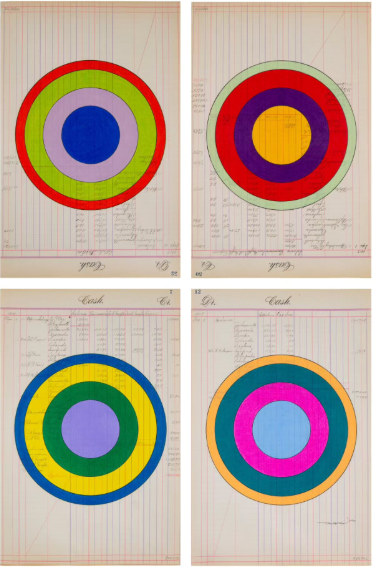
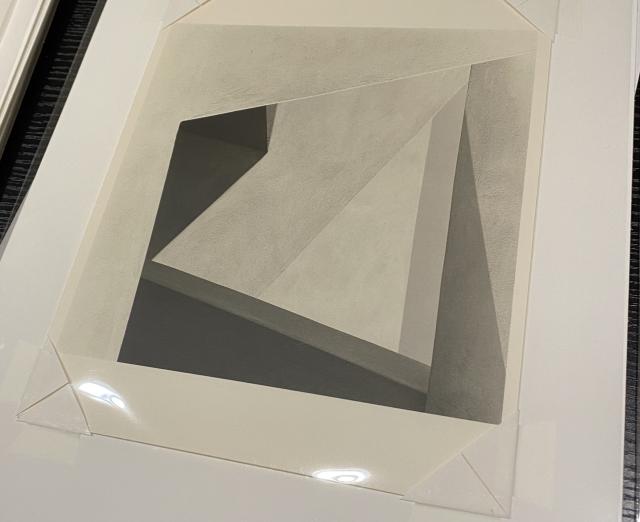
Terran Last Gun (Saakwaynaamah’kaa Last Gun) (Piikani, Browning, Montana, b. 1989) was born and raised on the Blackfeet Reservation. Last Gun’s multidisciplinary practice explores color, geometric form, nature, the cosmos, cultural narratives, and personal recollections through painting, drawing, printmaking, and photography. Terran Last Gun studied at the Institute of American Indian Arts, where he received degrees in Museum Studies and Studio Arts in 2016. He is based in Santa Fe, New Mexico.
A significant component of Last Gun’s practice engages with the historical tradition of Plains Indian ledger art, which emerged in the late 19th century as Native artists repurposed paper from settler ledger books—materials associated with the colonial and economic systems imposed upon Native communities—for visual storytelling. Last Gun reinterprets this tradition by combining ledger paper with abstraction and modernist color-field aesthetics, bringing historical and contemporary visual languages into dialogue.
Trustee Akio Tagawa met the artist at Indian Market Santa Fe while traveling with the Phillips this past summer. Save the date for Phillips in the Field: Santa Fe August 2027!
These two artworks by Morrison and Last Gun engage with the history of modern abstraction—a longstanding strength of the museum’s collection—from complementary perspectives. Morrison developed his bold and tactile abstraction within the postwar New York art scene where he became a significant figure. Last Gun, in turn, extends the possibilities of abstraction while drawing on the longer histories of Native American visual culture and the colonial experiences of Indigenous communities. By bringing these works into the collection, The Phillips Collection not only expands its representation of Native American artists, but also affirms that these voices are integral to the histories of modern and contemporary American art.