Tomorrow the Sun Will Rise: Alexandra Chiou
Exhibitions & Events
Learn more about the artists in Tomorrow the Sun Will Rise: The Phillips Collection Juried Exhibition (on view August 1-September 20, 2026).
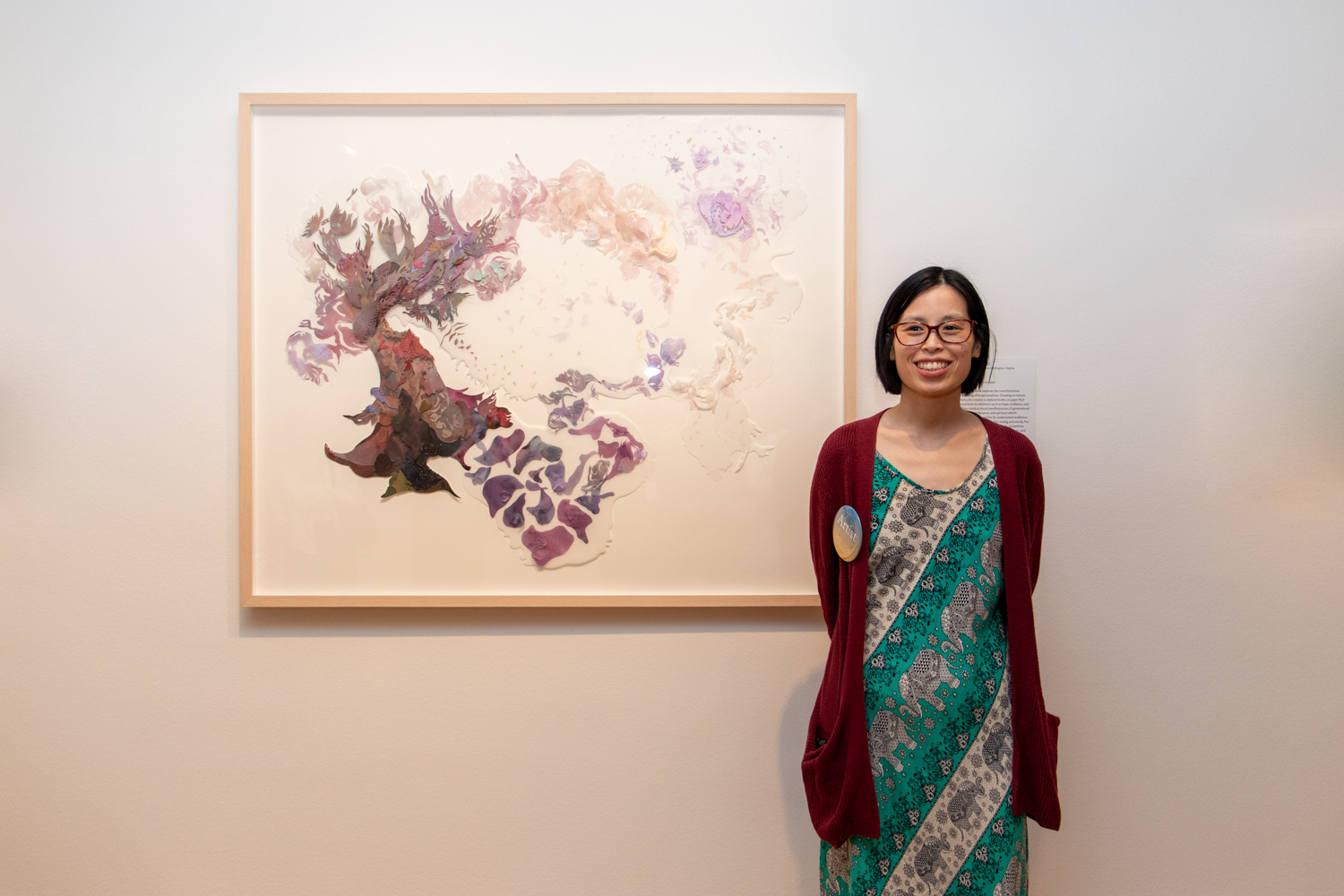
Tell us about your work in Tomorrow the Sun Will Rise.
Becoming Light was inspired by my recent trip to Taiwan, my late father’s birthplace, which I visited nearly three years after his passing. During this journey, I retraced his steps during his last visit to Taiwan, reconnected with family, and returned to my roots. The tree-like imagery on the left was inspired by the many banyan trees I encountered, especially those in Tainan, my father’s hometown. Their branches and aerial roots recall the tree of life, a symbol of beginnings and endings, and of continuous cycles. In this piece, I reflect on life and death, presence and absence, fading and becoming. The work gestures toward becoming light—toward transformation between the physical and spiritual, the visible and invisible—and the quiet beauty and peace found in the in-between.
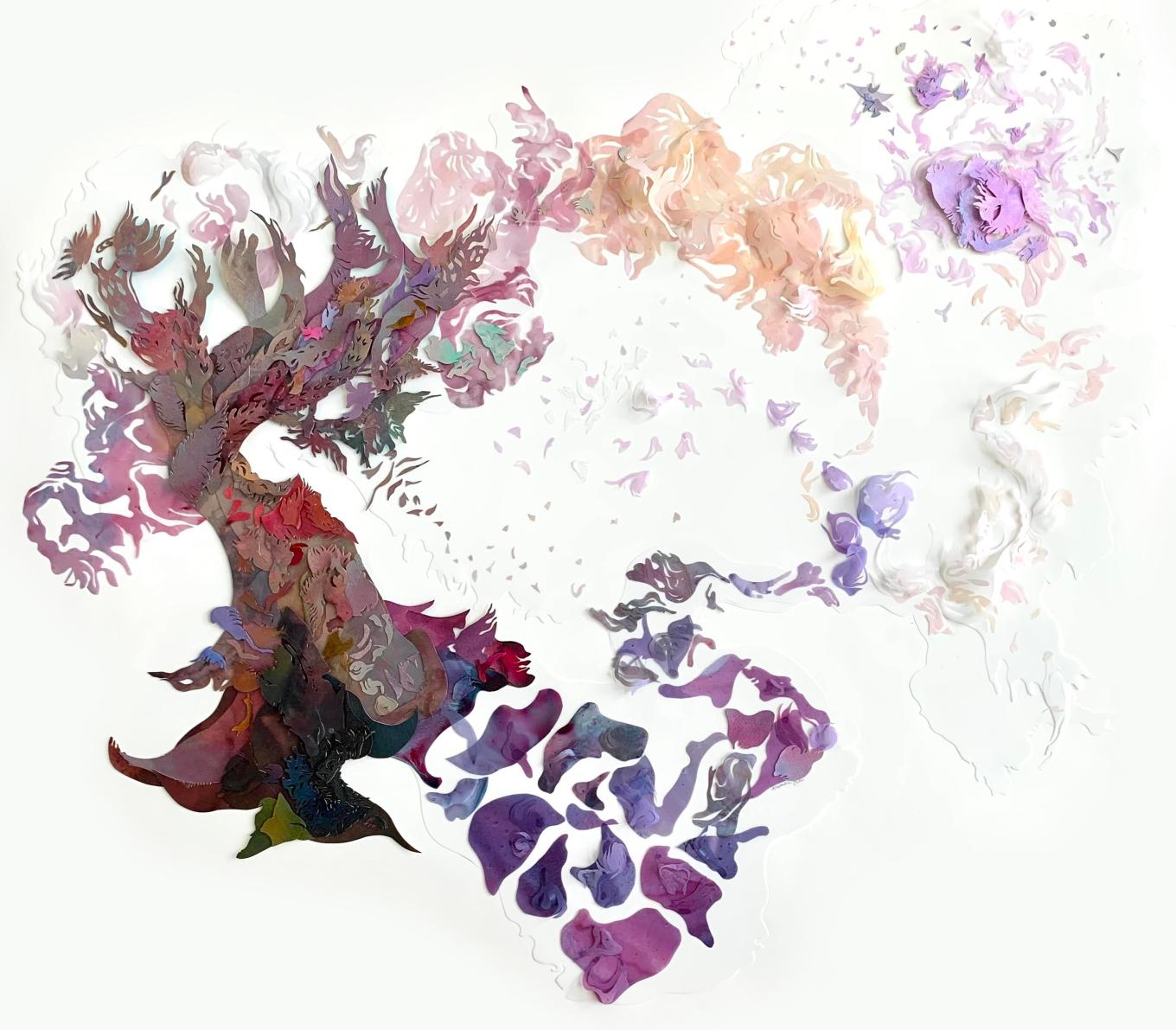
Alex Chiou, Becoming Light, 2025, Acrylic ink and hand-painted cut paper, 40 x 48 x 1 1/2 in.
Tell us about your artistic process.
My process begins with paper that I hand-paint, then cut, layer, and arrange into dimensional compositions. I am drawn to paper because it is a humble and malleable material that can be both fragile and resilient, qualities that I explore in my work.
Each piece is created through a labor-intensive process that balances careful construction with spontaneity. I often carve hundreds and thousands of precise knife cuts into hand-painted paper, creating individual fragments that are later arranged into larger compositions. I think of these pieces almost like puzzles or imagined landscapes, where color, form, and negative space gradually come together through an intuitive process of building, shifting, and layering.
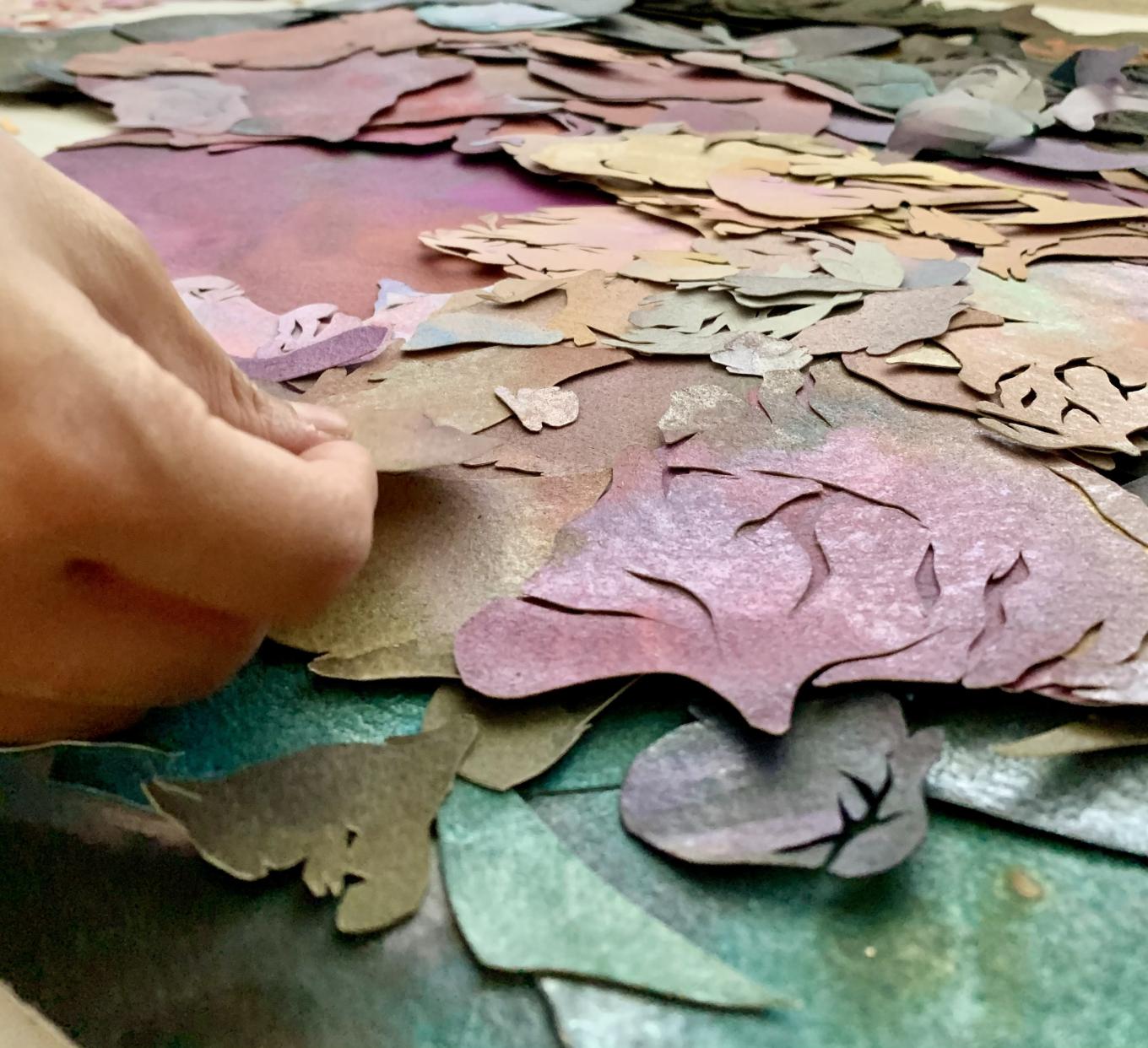
Alexandra Chiou, Process shot of The Kingly Garden, Acrylic ink and hand-painted cut paper.
Drawing on nature and memory, my recent work explores healing, transformation, and renewal. Forms appear to blossom, expand, dissolve, and reemerge across the surface, suggesting cycles of change, endurance, and regeneration. Through this process, I try to give physical shape to abstract experiences and emotions, creating works that hold both vulnerability and resilience.
What themes are central to your artistic process?
The central themes in my practice are healing, transformation, renewal, and memory. I am interested in how these experiences are often gradual, layered, and nonlinear, how something can shift, dissolve, reemerge, or take on new meaning over time.
Nature is an important source of inspiration because it offers so many visible reminders of change and regeneration. Forms bloom, decay, return, and transform, often in ways that feel both fragile and resilient. In my work, I draw on these cycles to explore emotional experiences that art can evoke better than words.
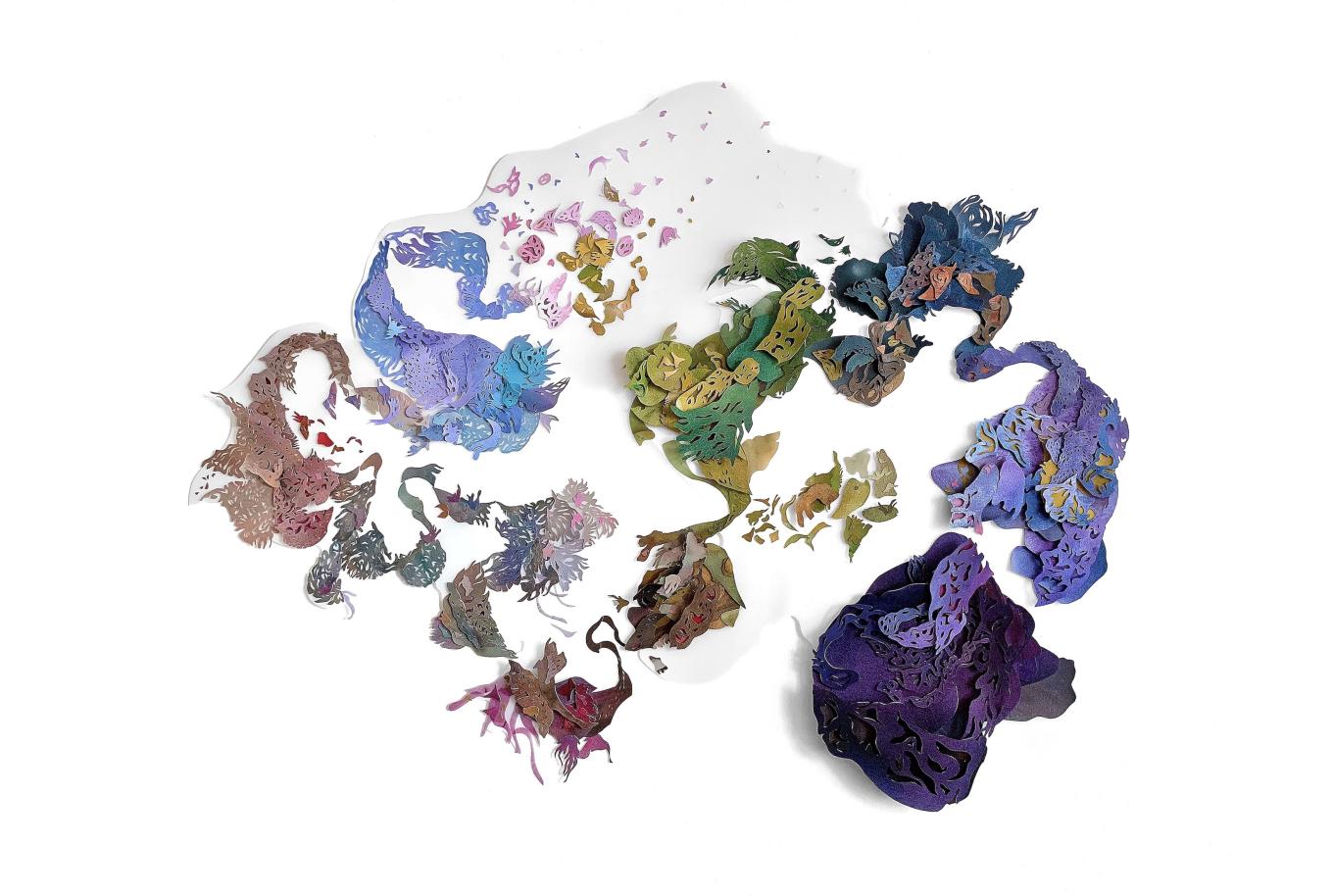
Alexandra Chiou, Pilgrimage, Ink and hand-painted cut paper, 32 × 42 × 2 in
These themes are important to me because they allow me to explore personal experience while also leaving space for broader connection. Through layered paper compositions, I give physical form to abstract feelings and ideas, creating works that reflect vulnerability, endurance, and the possibility of renewal.
How has living in the DMV area impacted and influenced your artistic journey?
I first moved to the DC area after graduating from college, and in many ways, this is where I began to understand what it meant to build a life as an artist. Spaces like Hamiltonian, Arlington Arts Center (now MOCA Arlington), and Project 4 Gallery were important to me in those early years as places where I found community, saw work by other emerging artists, and began to feel more connected to the local art scene. I learned a lot from conversations with other local emerging artists, and through the creative community I found here and the fellow creatives that I befriended.
Early support from places like Hillyer Art Space (now IA&A at Hillyer), Strathmore’s Fine Artist in Residence program, and Anacostia Arts Center gave me meaningful opportunities at a formative stage in my practice. I was also fortunate to have my work selected for Art in Embassies, something that could only happen here, given DC’s international scene. I found peace and quiet in local parks such as Rock Creek Park and Theodore Roosevelt Island; I drew inspiration from regular visits to the many world class museums here, some of my favorites including the Phillips, Renwick, Hirshhorn, and National Museum of Women in the Arts, all of which nourished my practice.
Although I went on to live in other cities for a period, many of the friendships, memories, and connections I made in the DMV have continued to be meaningful to me years later. Returning to the area has felt like reconnecting with a community that shaped me early on and continues to be part of my artistic journey.
What does it mean to you to be part of this exhibition?
It is truly an honor to be part of this exhibition. The Phillips Collection has always been one of my favorite museums in the DC area, and I have many fond memories of visiting its exhibitions and programs over the years. To now have the opportunity to share my own work here feels incredibly meaningful.
In some ways, it also feels like a full-circle moment. The DC area is where I found an early creative community and began to understand how to build a life as an artist. Being able to return and share some of my newest and strongest work with a local audience that helped shape my early years is very special.
Although my work is rooted in personal experience, I often think about broader themes of memory, healing, resilience, and transformation. I hope the work creates space for reflection and resonance, especially during a time when many people are seeking moments of stillness and connection. For me, art offers a reflective way to recognize shared experiences and to remember our capacity for empathy, openness, and understanding.
Anything else you would like to share about you/your art?
I would add that my creative process is very slow, intentional, and labor-intensive, and much of its meaning comes from the time and care embedded in the process. Each piece is built through many small, repetitive gestures—painting, cutting, layering, arranging—until individual fragments begin to form a larger whole.
Because of that, I hope viewers spend time with the work and notice the details up close, while also experiencing the larger sense of movement, growth, and transformation. My hope is that the work offers a moment of quiet reflection and invites viewers to bring their own memories and experiences to it.