Tomorrow the Sun Will Rise: Sharon Cheuk Wun Lee
Exhibitions & Events
Learn more about the artists in Tomorrow the Sun Will Rise: The Phillips Collection Juried Exhibition (on view August 1-September 20, 2026).
Tell us about your work in Tomorrow the Sun Will Rise.
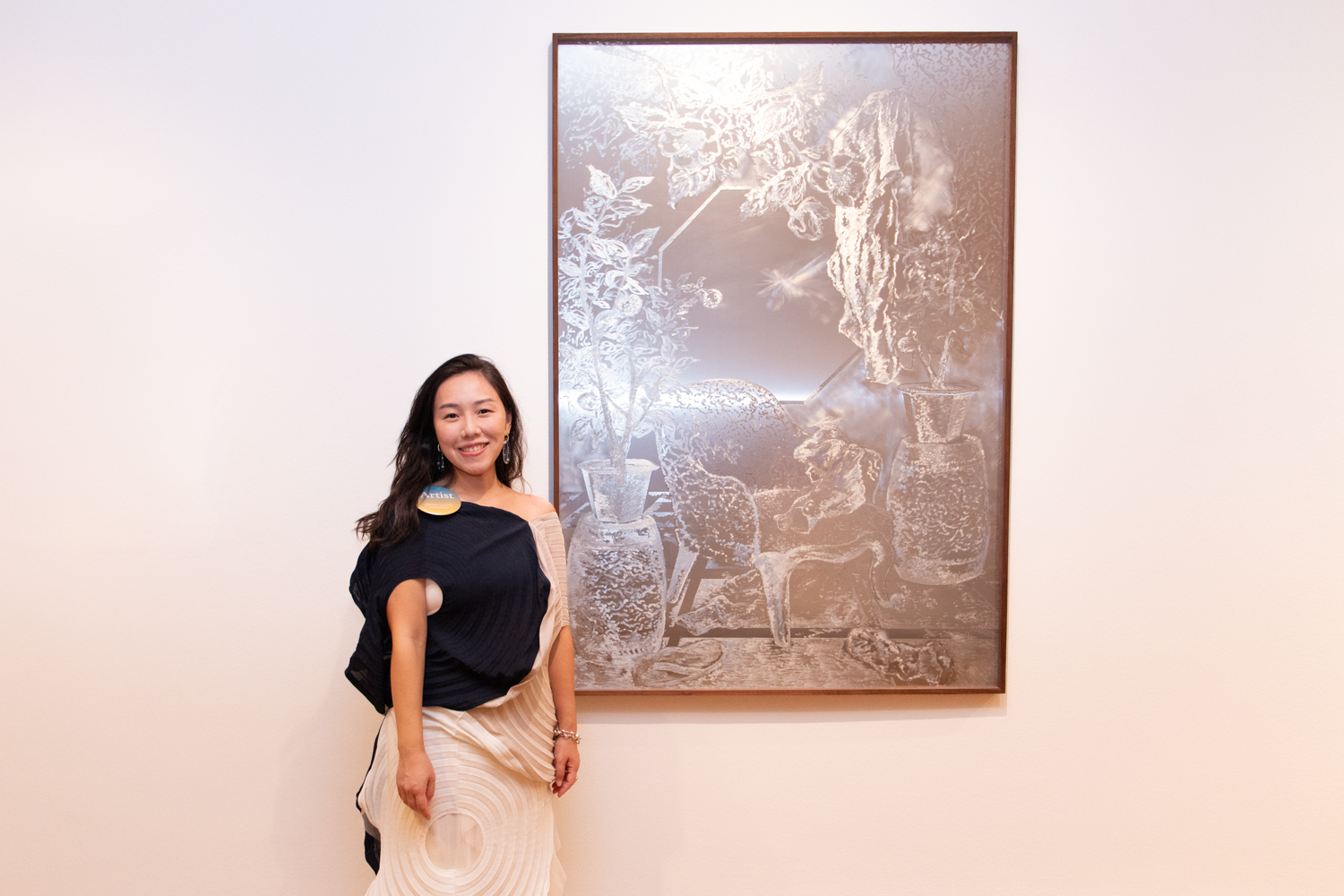
Afterimage: Borrowed Flora is an engraving on aluminium that uses the gestures of drawing to respond to historical photographs. Its shifting visual effect in between positive and negative images recalls early daguerreotype photographs, in which visibility changes according to the viewer’s angle and position. The work reconfigures 19th-century postcards depicting young Chinese women into empty relics centred on the presence of a laundry chair, reflecting on the erased histories of Chinese women’s immigration to the United States. Hong Kong historically served both as a port through which young women were sent abroad and as a site where many such portraits were produced. The work questions how power operates within imperial and colonial histories of image-making, circulation, and representation, particularly through the entanglement of female bodies and botany.
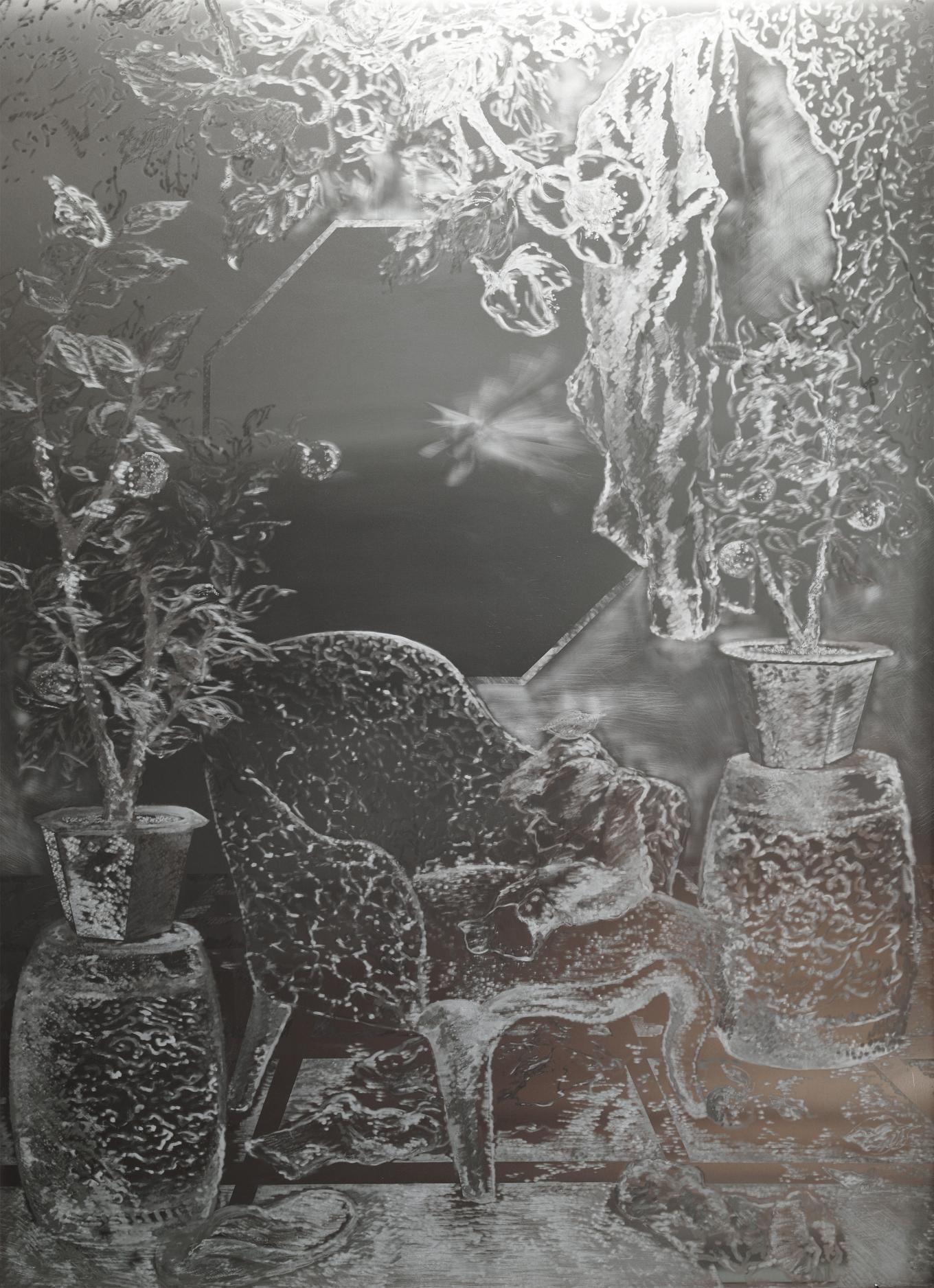
Sharon Cheuk Wun Lee, Afterimage: Borrowed Flora, Engraved aluminum in artist’s frame, 60 x 40 in.
These photographs often depict a woman seated on a chair, her body angled away from the camera in a pose that suggests passivity. Rather than meeting the camera’s gaze directly, she looks to the side, appearing to accommodate the gaze directed toward her. The sitter is surrounded by carefully arranged botanical elements, porcelain, fabrics, and interior furnishings. In my work, the photographic backdrop becomes the subject itself. By removing the sitter, I draw attention to her absence and to the power structures surrounding the female body: the labour, gaze, and systems operating both inside and outside the photographic frame.
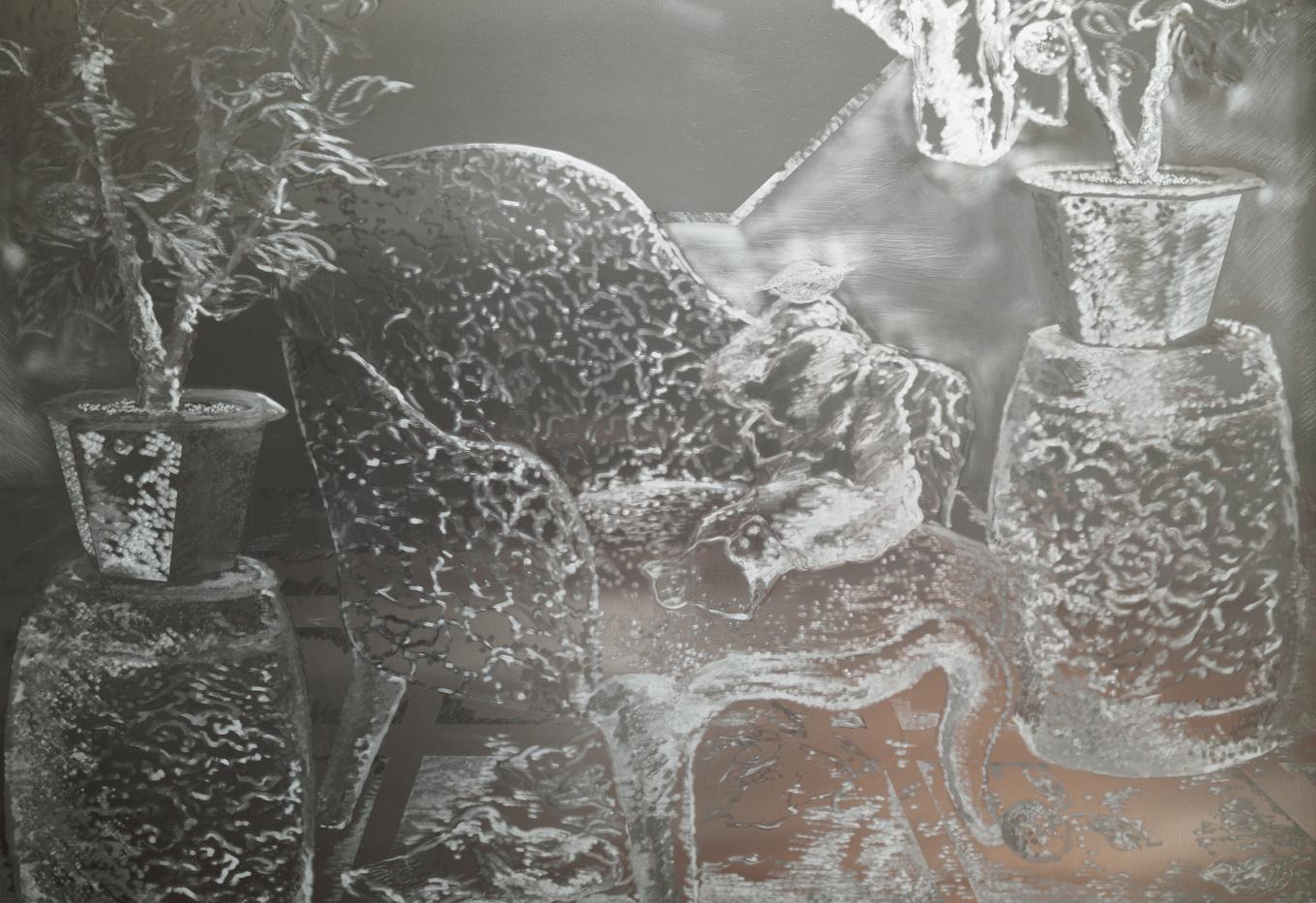
Sharon Cheuk Wun Lee, (detail) Afterimage: Borrowed Flora, Engraved aluminum, 60 x 40 in.
The composition also establishes a dialogue between these colonial postcard photographs and Western painting histories. In Jan van Eyck’s Arnolfini Portrait, objects such as the convex mirror and imported oranges function as subtle yet charged symbols within the background, complicating ideas of witnessing, presence and absence, class, and mobility. The work similarly plays with the reflection of a camera flash in the mirror positioned within the background, in contrast to the absent subject. It also depicts ornamental mandarin plants in the photo backdrop, originating from Guangdong in southern China, alongside local plant species. The work asks how bodies, objects, and botanical forms circulate and become entangled within visual culture and broader structures of power.
Tell us about your artistic process.
(Keywords: Sculpting light, engraving, drawing, slow looking, archives)
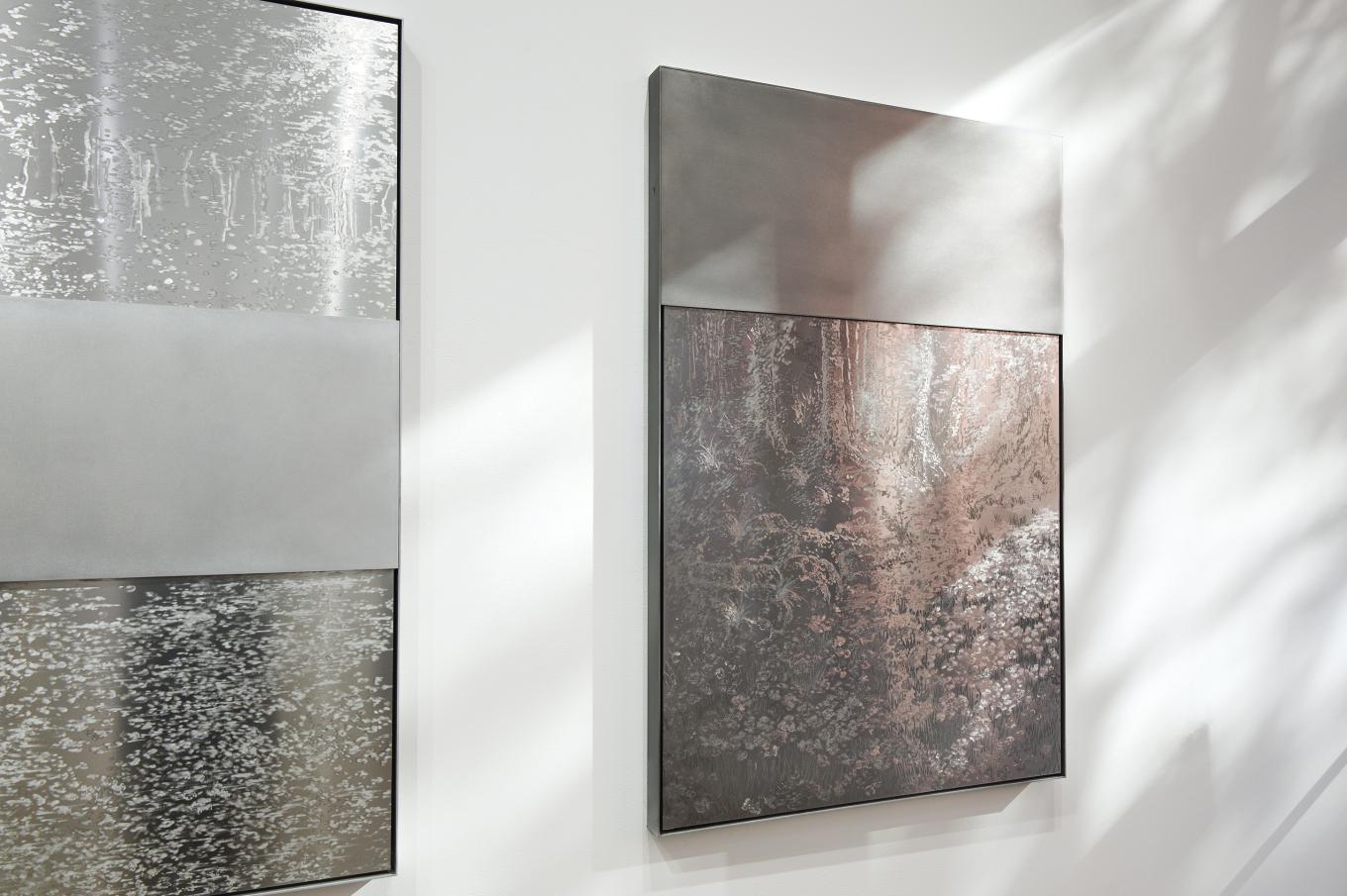
Sharon Cheuk Wun Lee, Poppy Field, Engraved aluminum in artist’s frame, 48.5 x 32.25 in, a set of 3.
Working between drawing and sculpture, I use engraving to transform archival research on botany into materially and optically unstable forms that resist fixity, like shimmer on water. Light functions as a sculptural medium in my work, animating engraved surfaces that shift with the viewer’s movement and perspective, creating an image in flux. Using abrasive tools on aluminum, I rework landscape photographs and botanical imagery through a slow, labor-intensive process that unsettles mechanical reproduction and foregrounds perception as an active encounter. The angle and direction of each mark are calibrated according to how light reflects across the surface. Hovering between presence and disappearance, image and object, memory and projection, these fragmentary traces become a way of reflecting on contested forms of longing and belonging.
I was drawn to aluminum as an engraving surface after learning of its use in seed banks, and later extended this material investigation through unweaving garden mesh. By repurposing materials associated with preservation and containment, I develop a visual language that addresses displacement, vulnerability, and the fragile conditions of coexistence.
What themes are essential to your practice, and why are they important to you?
Keywords: (landscape, botany, presence of absence, flux, crossings, relational forms, embodied memory, colonial relic)
Shaped by crossings and displacement, my practice examines how botany and landscape are entangled with colonial histories, migration, and diasporic formations through oceanic and riverine perspectives. Coming from Hong Kong—a port city in flux, marked by rupture and continuous transformation—I am drawn to the uncertainties and in-between spaces within the archive.
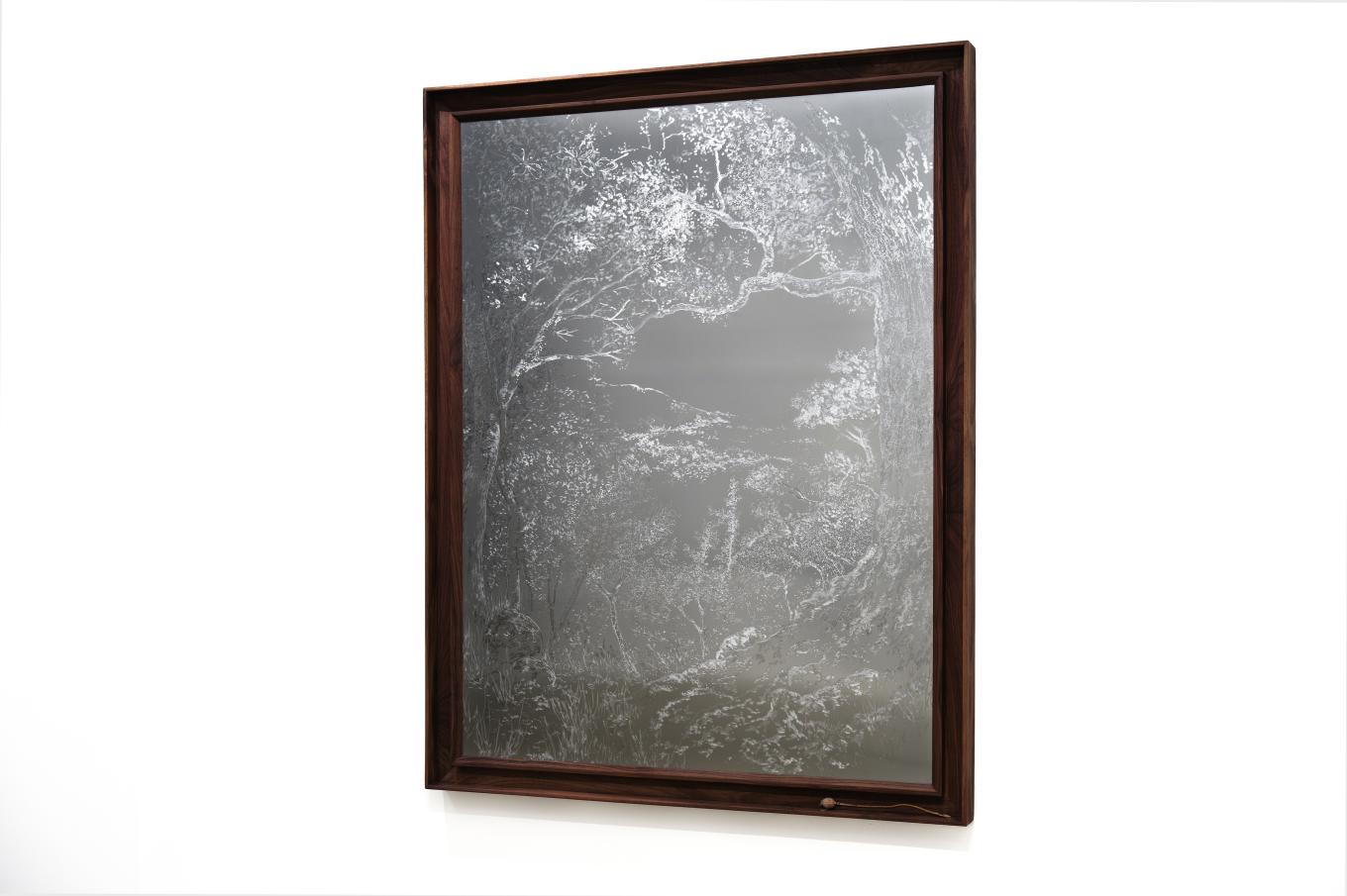
Sharon Cheuk Wun Lee, Possibly, There, Engraved aluminum in artist’s frame with dried poppy pod and Hong Kong dollar coins, 64 x 48 in.
Landscape and botany are also deeply personal to me. I grew up in a mountainous part of the city, where plants were woven into everyday life. As a child, I played with pine cones, made sketches outdoors, and used leaves as remedies for scraped knees. I am drawn to this intimate and familiar lens as a way of rereading histories and memories.
This long-standing inquiry expanded through a public commission for the Hong Kong Zoological and Botanical Gardens, where I began researching colonial botanical networks and the politics embedded within cultivated landscapes. Wish You Well is a public art project commissioned for the Gardens, a site dense with collective memory and colonial history. The work began amid political turbulence and a global pandemic, when I sought to give hope a tangible form. It adopts a relational approach to reclaiming the site through small gestures and slow looking, asking what hope might mean personally, collectively, and across time.
A quiet rainbow appears in the fountain, which has been rebuilt three times over the past century. I use the rainbow as an invitation to collective wish-making, asking how histories and sites might be reclaimed through intangible and vulnerable gestures. On the fountain, I inscribed the words, “Here lies the rainbow for wishful thinkers,” reimagining the site as a place for communal wishing and for reclaiming the private as public. Although the site was identified as a “Public Garden” in colonial postcards, it was originally the private garden of the British commander-in-chief and continued to be referred to as such by locals.
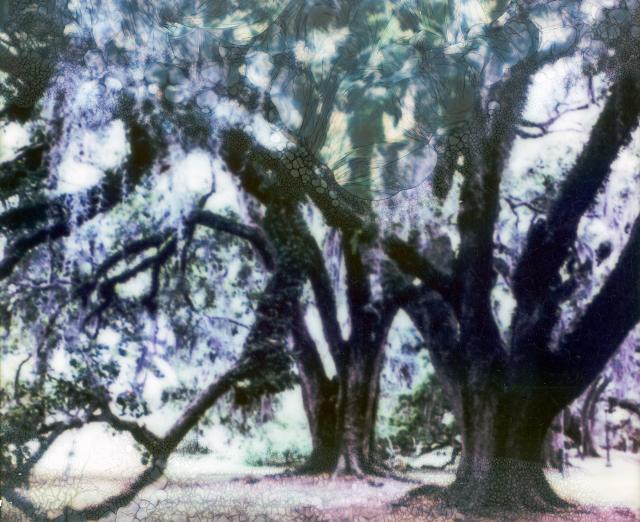
The work is time-based, site-specific, and relational. I use Polaroid photography to record each act of wishing. The instability of the Polaroid surface: its colours shifting with temperature, humidity, and time creates another kind of rainbow, one that continues to transform with each passing moment and gesture.
How has living in the DMV area impacted and influenced your artistic journey?
One of the highlights of my living experience in the DMV area has been my artist residency at the Oak Spring Garden Foundation in Virginia, where I was immersed in landscape, plants, gardening, and archival research all at once. The foundation’s library introduced me to some of the most unique manuscripts I have encountered, particularly a botanical dictionary featuring hand-painted illustrations in ink and pigment accompanied by Cantonese phonetic translations.
This discovery opened up an entirely new direction in my research, allowing me to consider how Hong Kong, my homeland, played a role in the exchange and circulation of botanical knowledge and language. It reinforced my understanding that nature is never neutral; it is continually shaped by systems of representation, classification, and circulation. Plants and landscapes can hold histories of trade, migration, war, beauty, and vulnerability.
What does it mean to be part of this exhibition?
This exhibition marks my first presentation in a museum in the United States since relocating from Hong Kong. I have long been impressed by the way The Phillips Collection brings artworks together through non-chronological and unconventional arrangements, creating meaningful visual dialogues across different artistic expressions, historical periods, and cultural contexts.
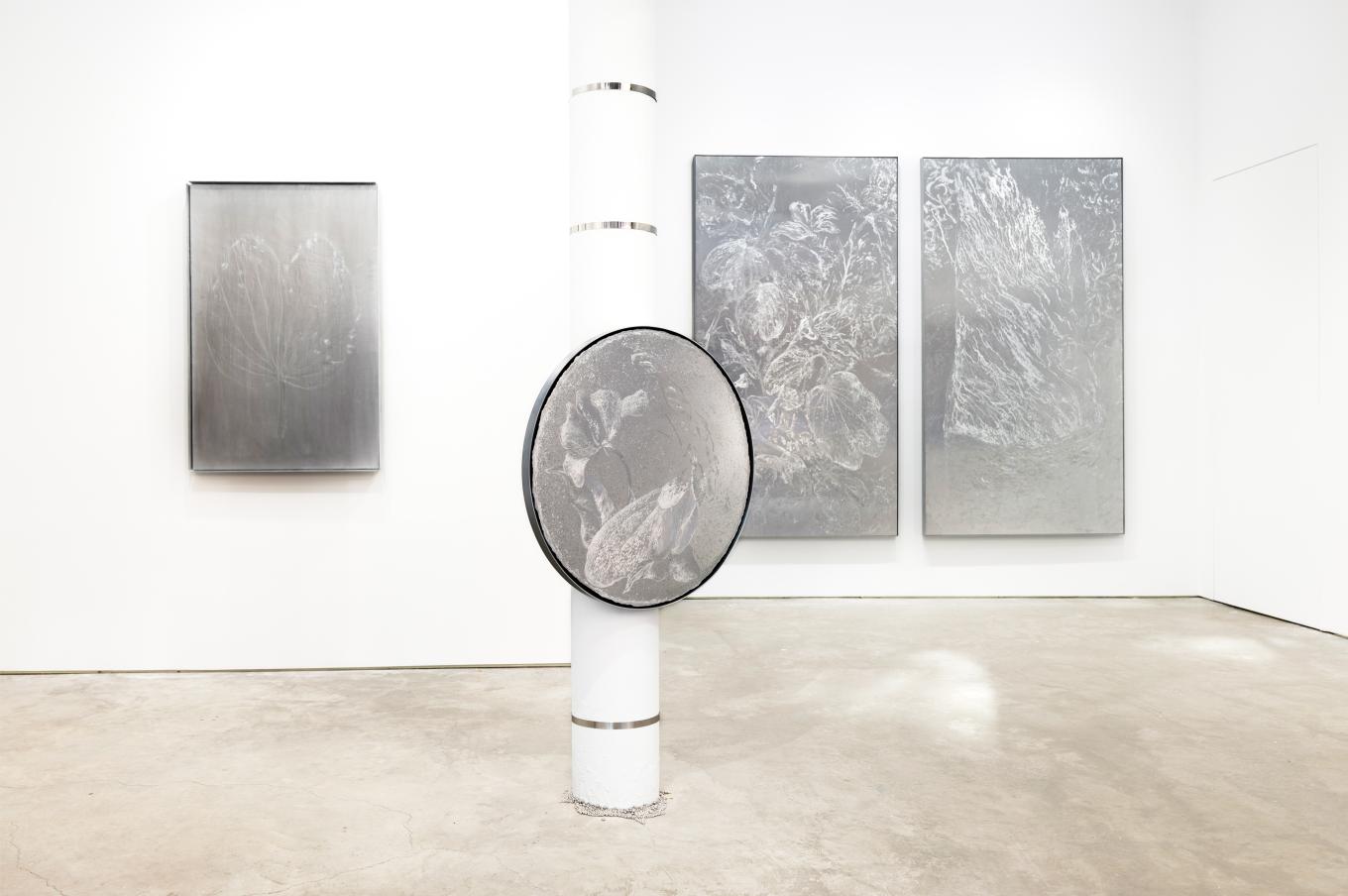
Sharon Cheuk Wun Lee, Possibly, Here, solo exhibition, Harper’s Gallery, Chelsea, New York City.
As an artist whose practice is interdisciplinary and whose visual language moves between cultures, I find this approach especially resonant. The exhibition offers a meaningful platform for my work to enter into conversation with the museum’s collection, with historical masterpieces, and with the work of my contemporary peers in the region. To be part of this dialogue, between past and present, classical forms and contemporary expression, is both significant and deeply encouraging to me.
Anything else you would like to share about you/your art?
Trained in photography yet resistant to the camera’s claims of certainty and speed, I employ a slow, labor-intensive process of drawing with light to create images that remain in flux. My work unsettles the authority of mechanical reproduction and foregrounds perception as a contingent, embodied act.
In my recent solo exhibition, I work between drawing and sculpture, using hand engraving to transform archival and found photographs into materially and optically unstable forms that resist fixity, like light shimmering across water. Treating light as a sculptural medium, I calibrate the angle, depth, and density of each engraved mark so that images emerge and dissolve with the viewer’s movement and perspective.