Tomorrow the Sun Will Rise: Ei Myat Noe Khin
Exhibitions & Events
Learn more about the artists in Tomorrow the Sun Will Rise: The Phillips Collection Juried Exhibition (on view August 1-September 20, 2026).
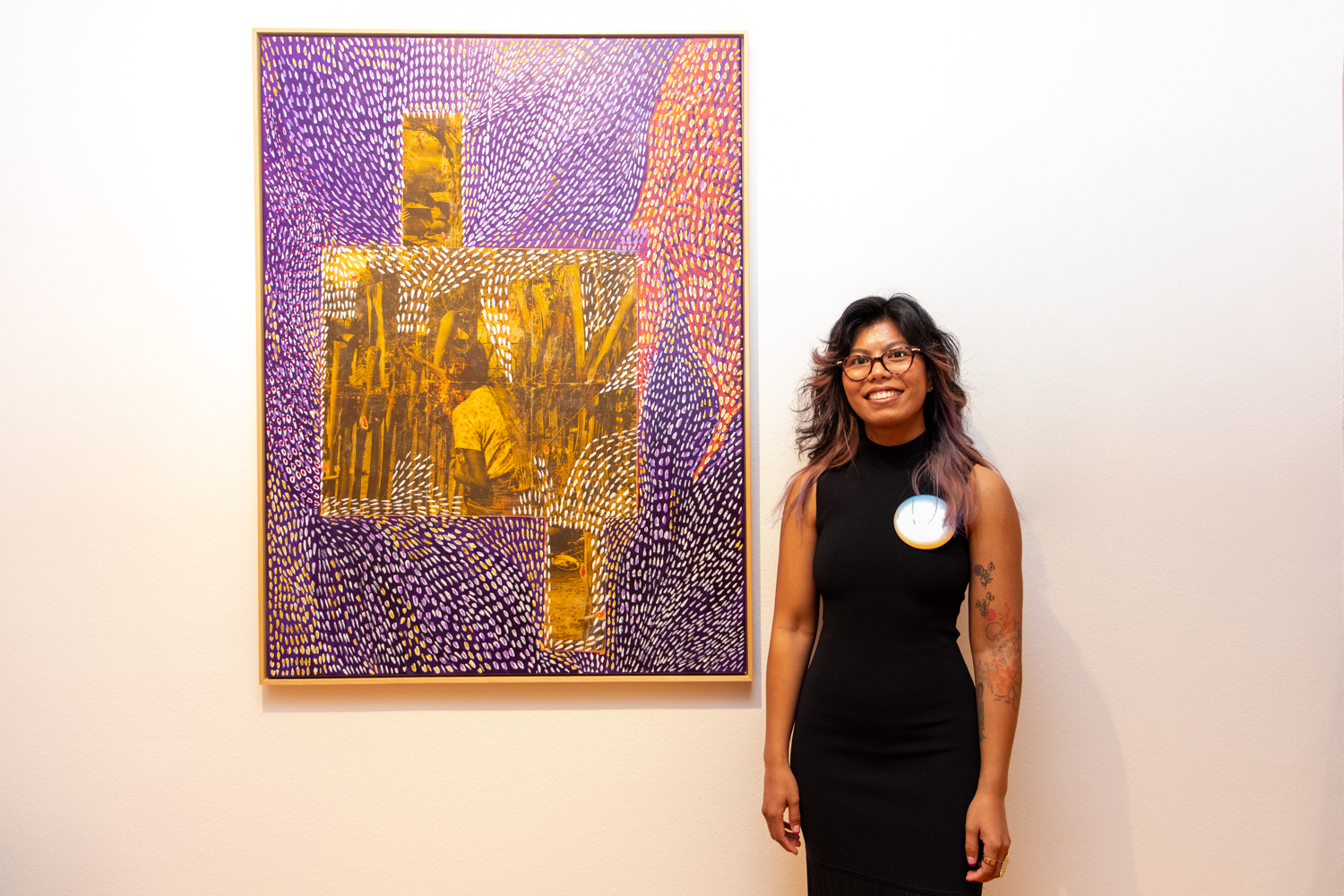
Tell us about your work in Tomorrow the Sun Will Rise.
Reminisce | Indigo Resilience is a way of processing and documenting the atrocities committed by the Myanmar military junta while honoring the resilience of the people who have lost or been separated from their loved ones. I created the artwork in 2024 in Chiang Mai, Thailand, while visiting, because it felt like the closest I could get to my country.
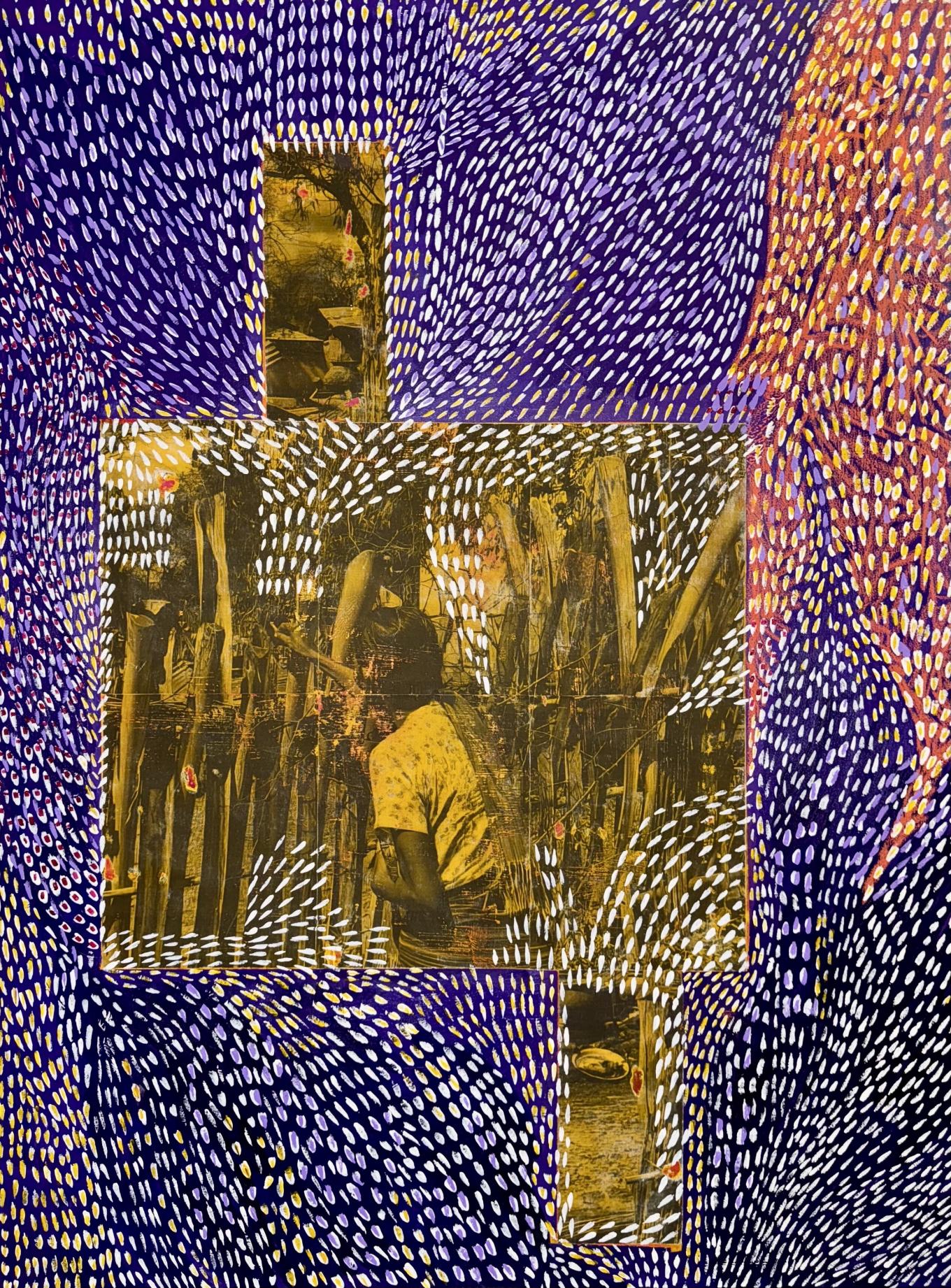
Ei Myat Noe Khin, Reminisce | Indigo Resilience, Photo printed on paper, acrylic, oil pastel on canvas, 47 x 39 x 1 in.
While I was working on the painting, I asked friends and family to come visit me at the studio. It was also the first time my mother saw me work on a painting, after having seen my exhibitions in DC from afar. Everyone who came by immediately recognized the photograph I was working with. One friend left as soon as he saw it because it was too painful. The others stayed and began talking about the photo, about the Myanmar movement, and about how we had all been living since the coup. My family and friends have been scattered throughout the world since 2021, and it felt bittersweet to speak about Myanmar while being in the same physical space together again.
On October 17, 2024, military council forces raided Sipa village in Budalin Township, destroying nearly 300 of its 500 homes. Six people were killed, five of them Sipa residents: U Tin Hlaing (78), U Kyaung Po (65), U Htet Aung (42), U Hla Sein, and U Thein Lwin, all of whom were brutally mutilated. In the photo at the center of this piece, U Kyaung Po’s sister is shown on one of her daily visits to the site of his death, leaving a cigarette in his memory, as he was known for his love of hand-rolled cigarettes. Almost everyone from Myanmar would recognize this photo and its story.
When I learned about this news, I was filled with rage. The only thing that soothed me was seeing that, instead of doing nothing but rage, U Kyaung Po’s sister was thinking of her brother and visiting him with the cigarettes he used to love. She was putting her love first and foremost. The purple in this artwork symbolizes hope and aims to soothe those who have lost loved ones, while the layered textures convey the intensity of their emotions. I wanted to bring this story forward, as I long for the day the military junta is brought to justice for all of its crimes.
Tell us about your artistic process.
When I begin a piece, I have an idea of what I want to work on and the story I want to convey. I use bold colors and textured surfaces to express complex feelings such as dissociation, longing, strength, and tenderness, all held together in a single moment. I incorporate self-portraits and photographs from an eventful time: the pro-democracy protests following the 2021 military coup in my home country of Myanmar (Burma). These photos show how I was feeling at the time—lost, afraid, and resilient. I use them as the base for my paintings, adding layers of texture with acrylic and oil pastel.
I add layers of elongated teardrop strokes that carry different narratives and emotions in each artwork. In some works, the elongated teardrop strokes represent isolation, grief, anger, strength, and hope. In others, they represent how uncertainty and stillness make me feel, the countless events unfolding around us, and how we all move through life.
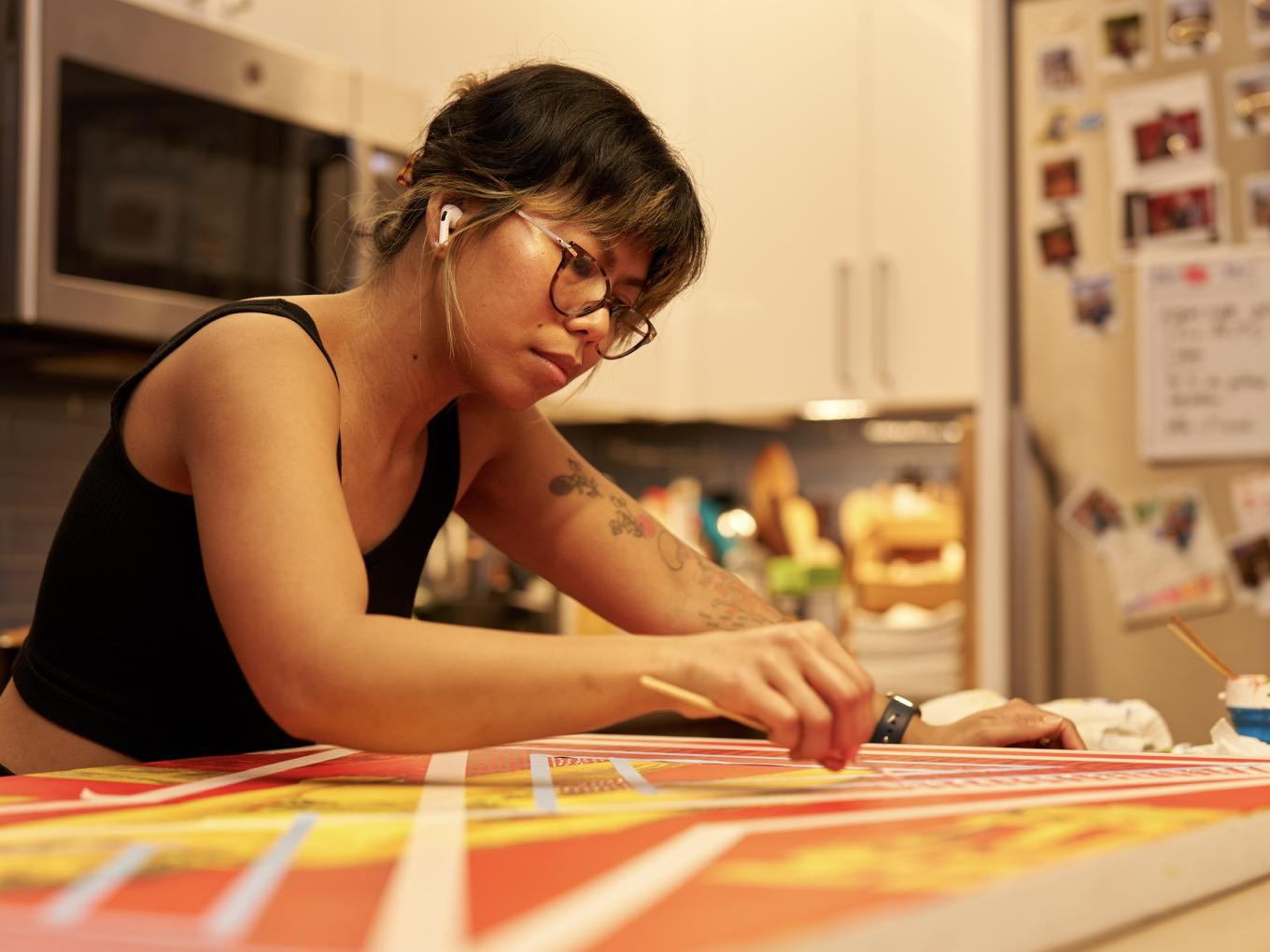
Ei Myat Noe Khin, Work in progress photo of Feeling Orwellian.
In other pieces, I scratch the surface to create a rough, scab-like finish. This is how I show trauma—something that is healing but still painful, especially when retriggered. Sometimes, I use dried petals, leaves, and other organic materials to represent how fragile and temporary life can be. These elements break down over time—just like memory, relationships, and the body itself.
Through self-portraiture, layered textures, and elongated brushstrokes, I explore what it means to survive mass violence and still reach toward healing. So many people are living through silent struggles, widely unknown but deeply felt. I hope my work invites them to witness, to feel, and to remember.
What themes are central to your artistic process?
My practice centers on diaspora, collective memory, grief, and resilience—all deeply shaped by my connection to Myanmar and its pro-democracy movement. Growing up in the dictatorship, the struggle for freedom was never abstract; it lives in my family, my friendships, and my daily thoughts. Painting is how I process what cannot be said plainly and how I keep memory in motion. I use bold colors and textured surfaces to express intense emotions.
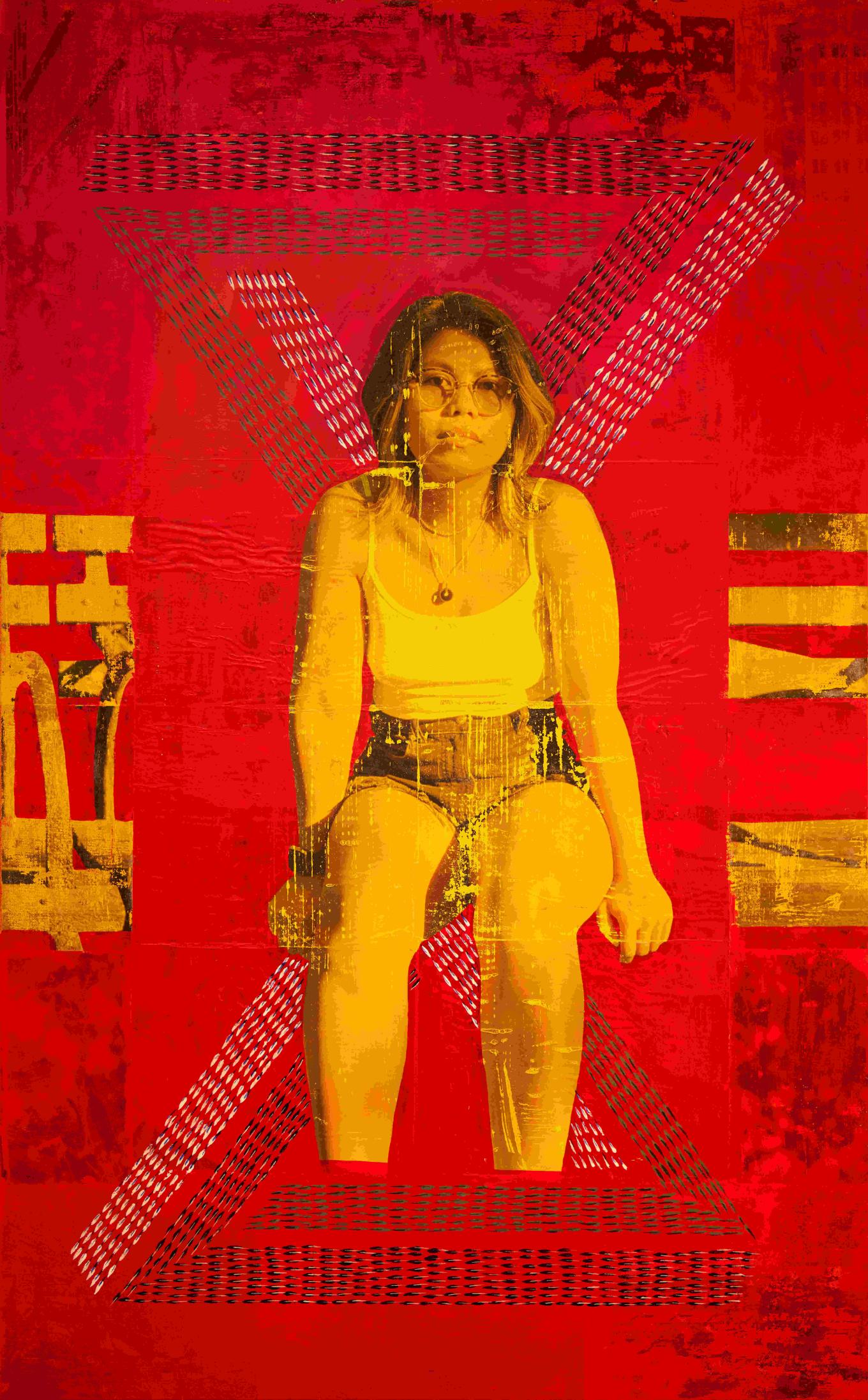
Ei Myat Noe Khin, Feeling Orwellian, Photo printed on paper, acrylic on canvas, 30 x 48 in.
These themes matter to me because they are shared. Every diaspora community carries the weight of remembering across distance, and I want my work to hold space for that experience. While some of my paintings look back at the home I left behind, my newer work looks forward to the home I am building now. Together, these pieces honor Myanmar’s pro-democracy movement, give honest form to diasporic struggle, and trace an emerging sense of belonging in Washington, DC. Sometimes the most powerful form of defiance against oppression is simply to stay alive, thrive, and tell our stories—and in my case, to paint them.
How has living in the DMV area impacted and influenced your artistic journey?
When I first moved to DC after the 2021 military coup, I came to work in human rights. I never imagined I would use art to tell my own story or to shine a light on Myanmar’s ongoing pro-democracy movement. Back in Myanmar, the art world is very exclusive, and exhibiting my work felt out of reach. But DC’s rich landscape of local galleries and public programs changed that and shaped me into a visual artist.
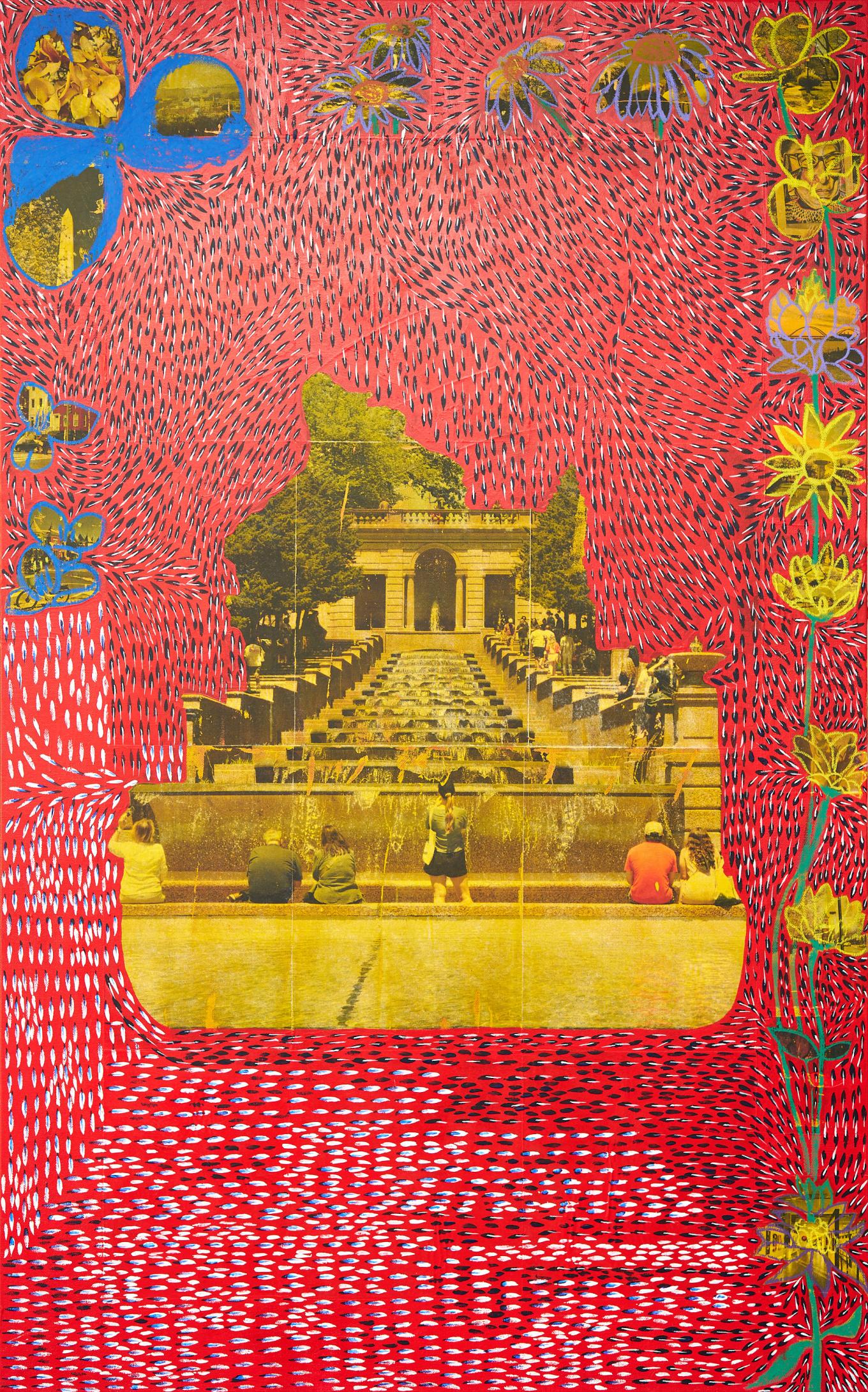
Ei Myat Noe Khin, A shared map of the Chocolate City, Photo printed on paper, acrylic, oil pastel on canvas, 30 x 48 in.
In this space, I have also had the chance to connect with artists and curators who are genuinely supportive of one another. Their encouragement helped me take myself seriously as an artist. Seeing how they build their practices and lift each other up made me think about who I want to be as an artist, what stories I want to tell, and what steps to take next. Now I am getting the opportunity to exhibit my artwork at The Phillips Collection, something I could never have imagined when I first arrived.
What does it mean to you to be part of this exhibition?
Being part of Tomorrow the Sun Will Rise at The Phillips Collection is one of the most meaningful moments of my artistic journey. The title itself speaks the language of my practice. It is a promise that darkness is not the end of the story, which is the same promise I try to paint.
I am deeply grateful to the curators and The Phillips Collection for championing artists from the DMV and creating space for stories like mine to be seen and heard.
Showing at an institution like The Phillips Collection carries real weight. It brings visibility not only to my work but to the stories behind it: the people of Myanmar, the ongoing pro-democracy movement, and the experience of diaspora communities who are holding grief and hope at the same time.
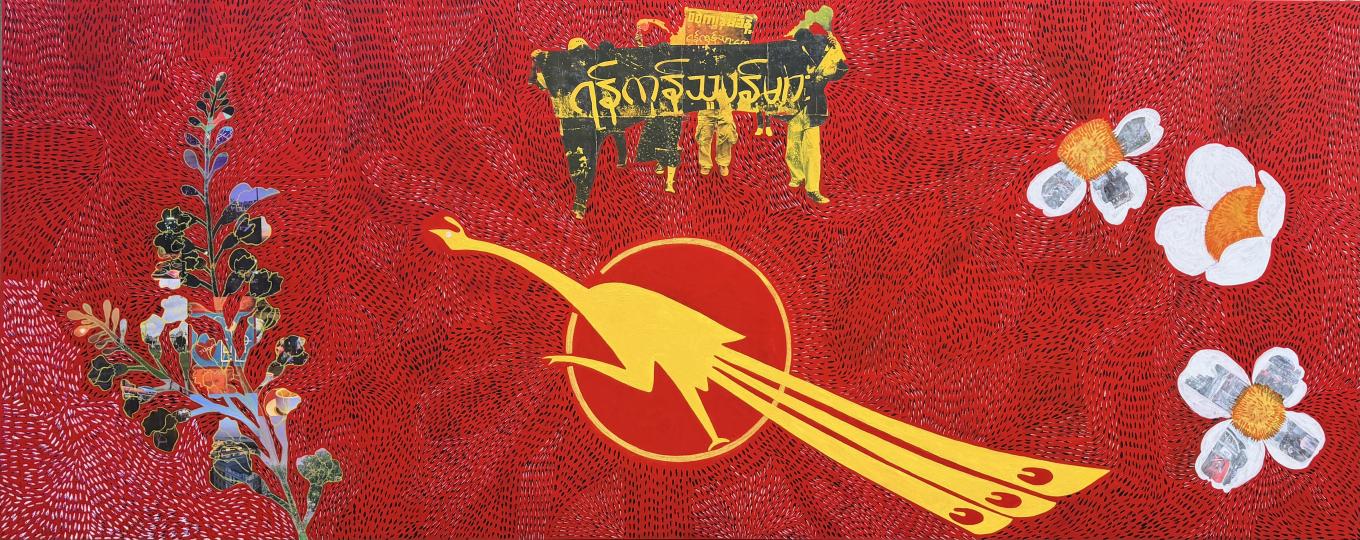
Ei Myat Noe Khin, Pyan Sone Kya Mal (We Will Meet Again).
Anything else you would like to share about you/your art?
I recently completed the largest artwork I have ever made, Pyan Sone Kya Mal (We Will Meet Again), measuring 4 by 10 feet. In this piece, I paint two of Myanmar’s native flowers, Padauk and Kant Kaw, alongside photographs taken in Yangon before the coup and during the peaceful protests, preserving those memories.
Padauk blooms in brief, golden-yellow bursts each April, around the time of Myanmar New Year and the Thingyan water festival. It represents new beginnings and hope. Thingyan, also known as Songkran in Thailand, Pi Mai in Laos, and the Cambodian New Year, is one of my favorite traditions in Myanmar. It spans four to five days of water festivals, music, and dance. The iconic water throwing is not just joyful chaos; it symbolizes washing away the old year’s troubles and making space for something new. Friends and family gather, cook all day, play in the streets, rest together, and give back: donating to senior homes, cleaning elders’ houses, visiting monasteries. During Thingyan, every household will have Padauk.
Kant Kaw is a deeply cherished flower, with bright white petals surrounding a vivid yellow center. It is especially meaningful to me because I grew up with a Kant Kaw tree in the front yard of my grandmother’s house. When it bloomed, its sweet fragrance announced the arrival of early summer.
The title of the piece, Pyan Sone Kya Mal (We Will Meet Again), is a promise that the separation we are living through is not forever. Working at this scale opened something new for me, and I am excited to keep exploring larger paintings and to find different approaches and styles as my practice grows.
Ultimately, I want people to know that my work comes from love. Even when the subject is grief or political struggle, the impulse behind every painting is love for a country, for a community, and for the people who keep going. If a viewer leaves one of my paintings feeling that resilience is beautiful and that memory is worth carrying, then the work has done what I hoped.